


Instant Stashfin UPI Security & Safety Guide
How your UPI payments are protected, and the habits that keep them that way
CHECK TRANSACTION STATUS
Need a Quick Way to Understand How Stashfin Keeps UPI Payments Safe?
UPI security rests on three things happening at once: the payment can only be authorised from the
device bound to your SIM, it can only be authorised with a UPI PIN that nobody but you knows, and
the merchant never sees the bank account behind your UPI ID. Together those mean a stolen phone
without your PIN, or a stolen PIN without your phone, is not enough to move your money.
Stashfin adds real-time monitoring on top of that framework and keeps your financial identity fully
masked on every transaction. The section below covers what the platform does, and — just as
important — the small number of habits that protect you from the fraud UPI cannot prevent on your
behalf.
Security Layers & What They Protect
| Security Layer | What It Protects Against | How It Works |
|---|---|---|
| Device Binding | Remote access from another phone | Your UPI profile is tied to the SIM and hardware of your device — it cannot be logged into or cloned elsewhere |
| UPI PIN Authorisation | Unauthorised outgoing payments | Every debit needs a 4 or 6-digit PIN that is verified by your bank, never stored on the platform |
| Masked Financial Identity | Exposure of your account details | Merchants and payers see only your UPI ID — never your account number, IFSC or card number |
| Bank-Grade Encryption | Interception of transaction data | Transaction IDs, reference numbers and personal financial information are encrypted end to end |
| Real-Time Fraud Monitoring | Suspicious and anomalous activity | Transactions are screened as they happen and unusual patterns are flagged for review |
| Direct Bank-to-Bank Routing | Funds sitting with an intermediary | Money moves between RBI-regulated institutions and never rests in a third-party wallet |
Features and Safety Best Practices for Stashfin UPI
The platform handles the technical layers. These are the habits that close the remaining gap — and
the reason almost every UPI fraud case succeeds is one of them being broken.
Your PIN Is Never Needed to Receive Money:
A UPI PIN authorises money leaving your account. If anyone asks you to enter your PIN, scan a QR
code, or approve a collect request in order to receive a payment, it is fraud. Stop there.
Never Share a PIN or OTP:
No bank, no Stashfin employee and no support agent will ever ask for your UPI PIN or an OTP. Anyone
who does is not who they claim to be.
Verify the Name Before You Pay:
UPI shows the registered name behind a UPI ID or QR code before you confirm. Read it. A single
wrong character in a handle sends the money to a stranger, and a completed payment to the wrong
person is not auto-reversible.
Treat Screen-Sharing Requests as Fraud:
Being asked to install a remote-access or screen-sharing app to "fix" a payment is one of the most
common UPI scams. Decline and end the call.
Keep Your Registered Mobile Number Current:
Device binding and OTP delivery both depend on it. If you change your number, update it with your
bank so a lost SIM cannot be used against you.
Report Fast:
If you notice a payment you did not make, report it to your bank immediately and change your UPI
PIN. The earlier a disputed transaction is raised, the more options exist to act on it.
Fraud attempts almost always work by creating urgency — a prize that expires, a refund that needs
approving, an account about to be blocked. Slowing down is the single most effective defence.
Why Pay via Stashfin UPI
Stashfin's utility ecosystem is engineered specifically to meet the speed, security, and convenience
required by modern consumers.
| Benefits | Stashfin | Other Platforms |
|---|---|---|
| Authentication | Hardware-level SIM binding with encrypted PIN entry | Manual password logins or multi-step SMS OTPs |
| Identity Exposure | Account number and card details fully masked from merchants | Card or account details shared with each merchant on file |
| Fund Custody | Direct bank-to-bank routing between RBI-regulated institutions | Funds may rest in a third-party wallet or holding account |
| Monitoring | Real-time transaction screening for anomalous activity | Periodic or batch review after the fact |
Pay Bills for All Your Needs


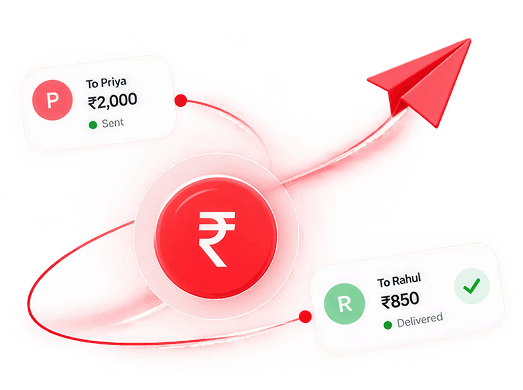
Move Money in Seconds
Whether you are paying rent, buying groceries, or splitting the bill, you can send money to any UPI ID or phone number instantly. There are no hidden fees, just pure speed!


Frequently Asked Questions
Everything you need to know about UPI security and staying safe
Yes, when the PIN stays private. A payment can only be authorised on the device bound to your SIM and only with your UPI PIN, and your bank account number is never shown to the merchant. A stolen phone without the PIN, or a PIN without the phone, cannot move your money.


