


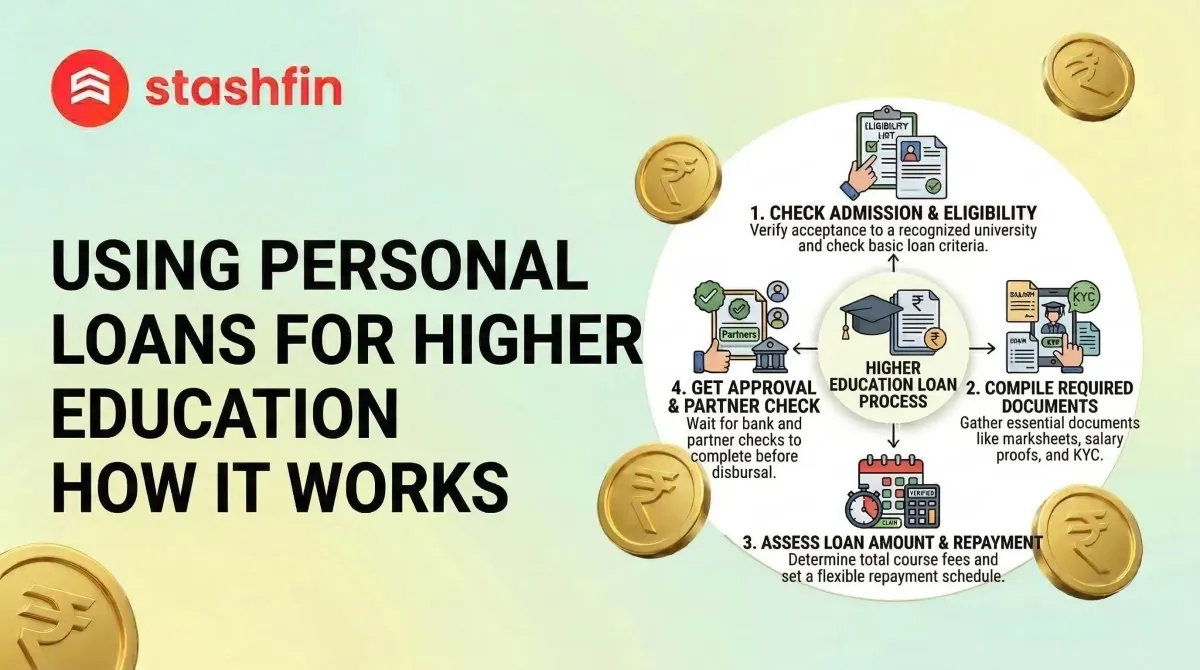
Using Personal Loans for Higher Education: How it Works?
Higher studies are no longer a fantasy; it's the desire of many Indian families, both in small towns and metros. Whether your goal is an MBA from Mumbai, a data science course from Delhi, or a postgraduate degree overseas, the fact remains: education in 2025 is expensive. Fees for higher studies, expenses for living, learning resources, and coaching classes add up quickly. And savings or grants do not always pay the bill.

That is where a personal loan for higher education can be a huge asset.
Compared to regular education loans, a higher education personal loan is faster to get, easier to use, and more flexible. It can help with not just tuition, but also rent, travel, exam fees, or coaching expenses. In this blog, we’ll break down when to consider this loan, how it compares to traditional options, who can apply, the pros and cons, and what students and parents in India need to know before deciding.
We shall guide you through the facts so that you can make informed decisions about your education process.
Why Consider a Loan for Higher Education?
Education, especially higher studies, is one of the most important investments you’ll ever make. But let’s face it, in India, the cost of that investment is growing fast. A 4-year engineering course at an IIT could cost ₹10–15 lakhs. An MBA from a top B-school? Think ₹25 lakhs or more. Studying abroad? That can easily cross ₹30–70 lakhs. Not every family is financially ready to make such a big decision.
So, if you’re wondering, “Can I take a personal loan for higher education”, instead of an education loan? Then the answer is: Yes, and that's because more and more individuals are opting for that path:
- No course limitations: Want to study baking in France or do a hybrid tech programme in foreign countries? Personal loans won't mind which course or school you attend.
- Quicker sanctioning: Personal loans at Stashfin are instantly approved. Much quicker than regular education loans.
- Do what you please: Pay your dues, purchase a computer, book your air ticket, pay rent, no rules.
- No security required: Most personal loans are unsecured, i.e., you don't have to mortgage property or gold.
For urban families in Patna or Pune, when saving or traditional lending is short of the funds needed, a higher education personal loan can bridge the gap and bring dreams within reach.
Higher Education Loan vs Personal Loan: Key Differences
Both loan types can help you fund studies, but they’re not the same. Knowing how they differ will help you pick the one that fits your needs better.
Here’s a quick comparison:
| Feature | Education Loan | Personal Loan for Education |
|---|---|---|
| Purpose-specific | Only for tuition, books, hostel, and approved expenses | Can be used for anything study-related (even travel, rent) |
| Collateral requirement | Often needed, especially for big amounts | Not required for smaller loans |
| Interest rates | Around 8–13% (sometimes subsidised) | Usually 10–15%, based on your credit score |
| Repayment starts | After the course + grace period | Starts right after disbursal |
| Documentation | Requires admission proof, fee slips, etc. | Just KYC, income proof needed, address proof, bank statements. |
| Co-applicant required | Usually needed (like a parent or guardian) | Optional |
So, in the higher education loan vs personal loan choice, if you need quick funds with fewer formalities and don’t want to pledge assets, a personal loan might be the better option, especially for smaller or flexible education needs.
Eligibility and Application Process for a Higher Education Personal Loan
So you're thinking, how to apply for a personal loan for higher education, it’s actually simpler than most people assume. Let’s break it down into two parts: who’s eligible and how to apply.
Who’s Eligible?
Eligibility rules vary a bit by lender, but here’s what most commonly applies:
- Age: You should be at least 21 years old.
- Credit score: A CIBIL score of 650 or above is typically preferred.
- Income: Either you or your co-applicant should earn at least minimum monthly income as per the policy.
- Employment: Earning individuals or self-employed professionals are eligible.
- Residency: Must be an Indian citizen with valid KYC documents.
Tip: If you're a student and don’t have a steady income yet, having a parent or guardian as a co-applicant can improve your chances of getting approved.
How to Apply
Here’s a quick step-by-step guide on how to apply for a personal loan for higher education:
- Check your eligibility on the lender’s app or website.
- Fill out the form with your personal, academic, and loan details.
- Upload your documents, like Aadhaar, PAN, salary slips or ITR, and recent bank statements.
- Wait for approval: Many lenders give you a decision in 24 to 48 hours. But with Stashfin, you can get instant approval and make the entire process hassle free.
- Get funds directly into your bank account once approved.
Advantages and Disadvantages of Using a Personal Loan for Education
If you're exploring options and thinking about getting an education loan without security, a personal loan could be just what you need. But like any financial choice, it comes with its share of pros and cons.
Advantages
- No collateral needed: You don’t have to pledge any asset, perfect for students or parents without property or savings to use as security.
- Fast disbursal: Many lenders approve and release funds within 24–48 hours. Ideal when you're racing against an admission deadline.
- Flexible usage: Unlike traditional education loans, you can use the money not just for tuition, but also for laptops, coaching, rent, travel, or any study-related need.
- Simpler documentation: Usually just basic KYC and income proof. No need for detailed fee structures or university documents upfront.
Disadvantages
- Higher interest rates: Personal loans usually charge 2–5% more than standard education loans, which can raise the overall cost.
- Immediate EMI starts: There’s no moratorium like in education loans. Repayments start as soon as the loan is disbursed.
- Shorter repayment period: Most personal loans come with a 1–5 year tenure, which means higher monthly EMIs compared to education loans with longer terms.
- Stricter credit checks: A low credit score or unstable income can lead to rejection or higher interest rates.
In a nutshell, if you're looking for an education loan without security and need quick, flexible funding, a personal loan can work well. But be sure to budget for repayments from day one, and compare your options carefully.
Loan for Higher Education in India: What Are Your Options?
If you're planning to study further, whether it's an MBA in Mumbai or a master’s abroad, getting the right loan for higher education in India can make all the difference. The good news? You’ve got more choices today than ever before.
Here are the top ways Indian students and families are financing higher studies in 2025:
- Public and Private Banks: Banks like SBI, HDFC, and ICICI offer structured education loans with lower interest rates and longer repayment periods. But they often need a lot of paperwork, like admission letters, fee breakdowns, and may ask for collateral, especially for big-ticket amounts.
- NBFCs (Non-Banking Financial Companies): Lenders like InCred or Avanse cater specifically to students heading overseas or opting for niche courses. They’re quicker than traditional banks and more flexible with course options, but the interest rates can be a bit higher.
- Fintech Platforms: If you want speed and minimal hassle, this is your best bet. Stashfin offers personal loans for education with quick disbursal, no restrictions on how you use the money, and very little paperwork. Perfect for tuition, coaching, travel, or hostel fees.
- Employer-Sponsored Loans or Advances: Some employers now support upskilling by offering interest-free salary advances or partnering with lenders to offer subsidised education loans to their employees.
- Peer-to-Peer (P2P) Lending: Still growing in India, but platforms like these let you borrow from individual investors, often at negotiable rates. Worth exploring if you don’t qualify easily elsewhere.
Whether you're a student from Bengaluru or a parent in Lucknow, knowing your options for a loan for higher education in India gives you more control over how and when you pursue your academic goals.
Conclusion
Higher education opens doors, but getting there often comes with a price tag. And in today’s world, scholarships and savings don’t always cover it all. That’s where a personal loan for higher education can help. It’s not just about the money; it’s about giving yourself or your child the chance to move forward without delay.
Of course, any loan needs thoughtful planning. Look at your repayment ability, read the terms carefully, and compare them with other funding routes.
Stashfin makes it easier to explore options tailored to your needs. Whether it’s tuition, coaching fees, or travel expenses, a personal loan might be the flexible, fast-track solution you need. Learn well. Plan smart. Borrow responsibly.
Note: Stashfin offers a unique benefit of 0% interest for up to 30 days on select credit lines, which can be highly beneficial for immediate, short-term education expenses.


