


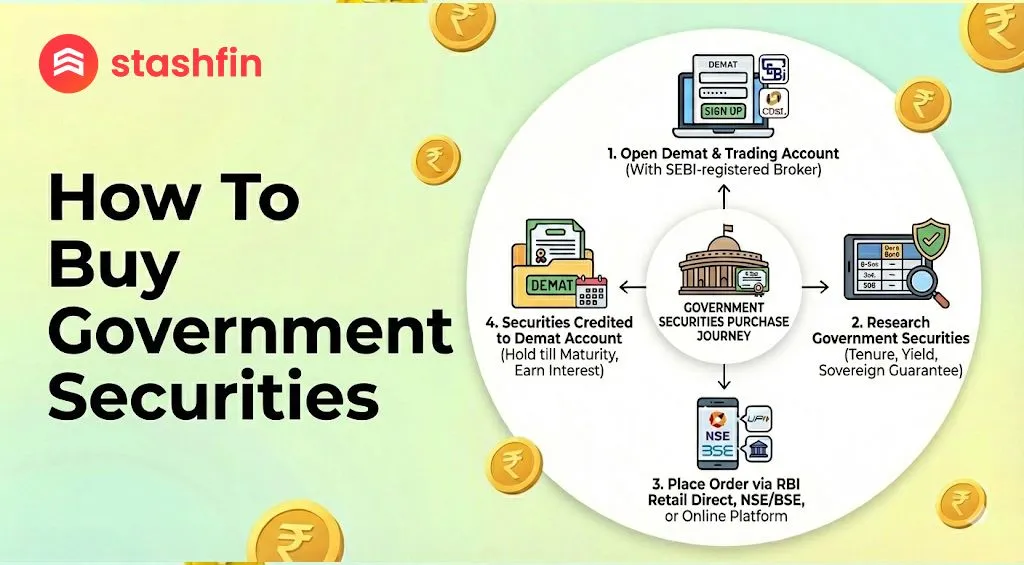
What are Government Securities?
Government Securities are also called G-Secs. Think of them as an "IOU" note from the government. When the government needs money to build roads, schools, or hospitals, they ask the public for a loan.

In return for your money, the government gives you a digital certificate. This certificate promises two things:
- They will pay you interest (called a coupon) every six months.
- They will give your original money back on a fixed date.
Types of Securities You Can Buy
There are four main types of securities available in 2026:
- Treasury Bills (T-Bills): Short-term investments lasting 91, 182, or 364 days. You buy them at a discount and get the full value back at maturity.
- Dated Government Bonds: Long-term investments ranging from 5 to 40 years. They pay interest twice a year.
- State Development Loans (SDLs): Issued by state governments (like Maharashtra or Tamil Nadu). They often offer slightly higher interest than central government bonds.
- Sovereign Gold Bonds (SGB): A way to invest in gold without holding physical bars. You benefit from rising gold prices plus a small fixed annual interest.
Why Should You Buy Them?
In 2026, many people are moving money from Bank FDs to G-Secs for these reasons:
- Total Safety: G-Secs carry a Sovereign Guarantee, the highest level of safety in India.
- Better Returns: 10-year bonds currently offer very competitive rates compared to big commercial banks.
- No Fees: Using the RBI Retail Direct portal involves zero commission, zero account opening fees, and zero holding charges.
- Tradability: If you need cash early, you can sell your bonds in the "Secondary Market."
How to Buy Government Securities (Step-by-Step)
Method 1: Using the RBI Retail Direct Portal
This is the most cost-effective method for long-term investors.
- Registration: Visit the official RBI Retail Direct website and register as a "Retail Investor."
- Video KYC: You will need your PAN and Aadhaar. A brief video call confirms your identity.
- Opening the RDG Account: RBI opens a Retail Direct Gilt (RDG) account, which acts as a digital vault for your bonds.
- Bidding: New bonds are sold weekly. You can participate via "Non-Competitive Bidding" with a minimum of ₹10,000.
- Payment: Use UPI or Net Banking. Bonds appear in your account within 2–3 days.
Method 2: Through Stock Brokers and Apps
If you use apps like Zerodha, Groww, or Upstox:
- Search for "Bonds" or "Govt Bonds" in the app.
- Choose a T-Bill or G-Sec and click "Buy."
- Bonds are stored in your existing Demat Account.
Method 3: Via Gilt Mutual Funds
For a "hands-off" approach, you can invest in a Gilt Mutual Fund where a professional manager handles the bond selection. You can start a SIP with as little as ₹500 per month.
Understanding Interest and Taxes
| Feature | Detail |
|---|---|
| Coupon Payout | Interest is usually paid every six months directly to your bank account. |
| TDS | No Tax Deducted at Source (TDS). You receive the full interest amount. |
| Income Tax | Interest is added to your total income and taxed according to your tax slab. |
| Capital Gains | No capital gains tax if held to maturity. Selling early may trigger tax. |
The Secondary Market: Selling Early
If you need your money before the bond expires, you can use the NDS-OM section on the RBI portal. This is a secondary market where you can list your bonds for sale to other investors.
Note: Bond prices can fluctuate. If market interest rates go up, the resale value of your existing bond usually goes down.
Summary Checklist for New Investors
- Choose between short-term (T-Bills) or long-term (Bonds).
- Decide on a platform: RBI Portal (Free) or Broker (Convenient).
- Ensure Aadhaar is linked to your mobile for OTPs.
- Have a minimum of ₹10,000 ready for your first investment.
- Complete Video KYC during bank hours (10 AM to 5 PM).


