


Need a High-Yield Alternative to Bank FDs?
In 2026, the RBI Repo Rate has stabilised at 5.25%, causing most major banks to offer FD rates between 6.5% and 7.3%. While FDs are the traditional choice for safety, many investors are now seeking "Fixed Deposit Alternatives" to beat inflation and grow wealth faster.

Corporate bonds, especially those of Akara Capital, have emerged as a powerful tool for those who want the "fixed" nature of an FD but with double the return potential.
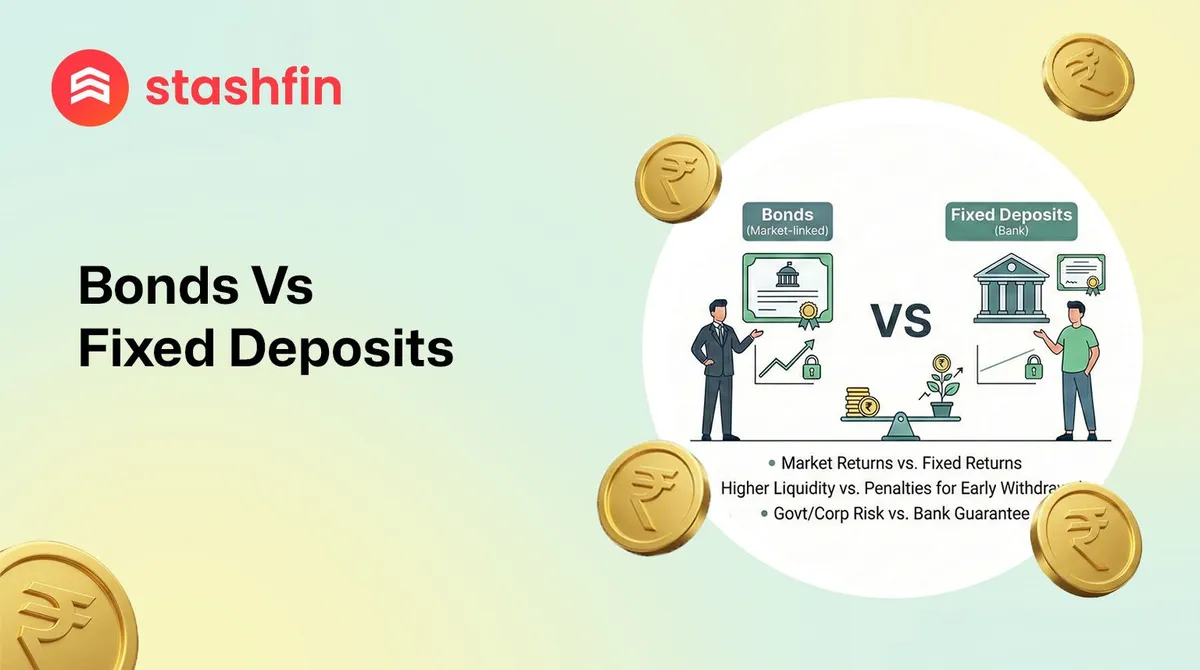
Features and Benefits of Bonds vs. Fixed Deposits
When you choose between a fixed deposit and a bond, you are choosing between two different lending models. Here is why the shift toward bonds is accelerating:
- Superior Returns: Corporate bonds typically offer a 2-5% "spread" over bank FDs to compensate for credit risk.
- Monthly Payout Flexibility: Unlike FDs where monthly interest often reduces the overall yield, bonds like Akara Capital are built for 14.5% monthly distributions.
- Zero Premature Penalties: To access FD funds, you often pay a 0.5%-1% penalty. Listed bonds can be sold in the secondary market at current market prices.
- Transparency through Ratings: Every bond has a credit rating, while FDs rely solely on the bank's brand.
- Inflation Protection: With returns at 14.5%, bonds provide a significant cushion against rising lifestyle costs that a 7% FD cannot match.
Why Stashfin for High-Yield Bond Investing?
Stashfin provides a digital bridge to institutional-grade debt that was previously only available to large investors.
| Feature | Traditional Bank FD | Akara Capital Bonds (Stashfin) |
|---|---|---|
| Annual Return | ~6.96% | 14.5% p.a. |
| Standard Tenure | 1 - 5 Years | 12 Months |
| Liquidity | Penalty on withdrawal | Tradable in Secondary Market |
| Safety | DICGC Insured up to ₹5 Lakh | BBB Rated (Investment Grade) |
| Payout | Mostly at Maturity | Fixed Monthly Returns |
Comparing Safety: The DICGC vs. Credit Ratings
Bank FDs: Your principal and interest are insured up to ₹5,00,000 by the Deposit Insurance and Credit Guarantee Corporation (DICGC). This makes them the "risk-free" benchmark.
Corporate Bonds: These are not insured but are Credit-Rated. An agency like ICRA or CRISIL evaluates the company's health. For example, Akara Capital's BBB rating indicates a moderate safety level with a stable outlook, justifying the higher 14.5% reward.
How to Apply for High-Yield Bonds
Transitioning from a fixed deposit bond to a corporate bond is 100% digital and takes less than 5 minutes:
- Sign Up: Enter your mobile number on the Stashfin app or website.
- KYC: Add your Demat account and complete your KYC.
- Invest: Use UPI or Net Banking to start with as little as ₹10,000.
Interest Rates & Charges Comparison
Understanding the cost of your investment is vital for calculating net returns.
| Fee Type | Bank FD | Akara Capital Bonds |
|---|---|---|
| Interest Rate | Fixed (Low) | Fixed 14.5% (High) |
| Premature Exit | 0.5% - 1.0% Penalty | Market Price (No Penalty) |


