


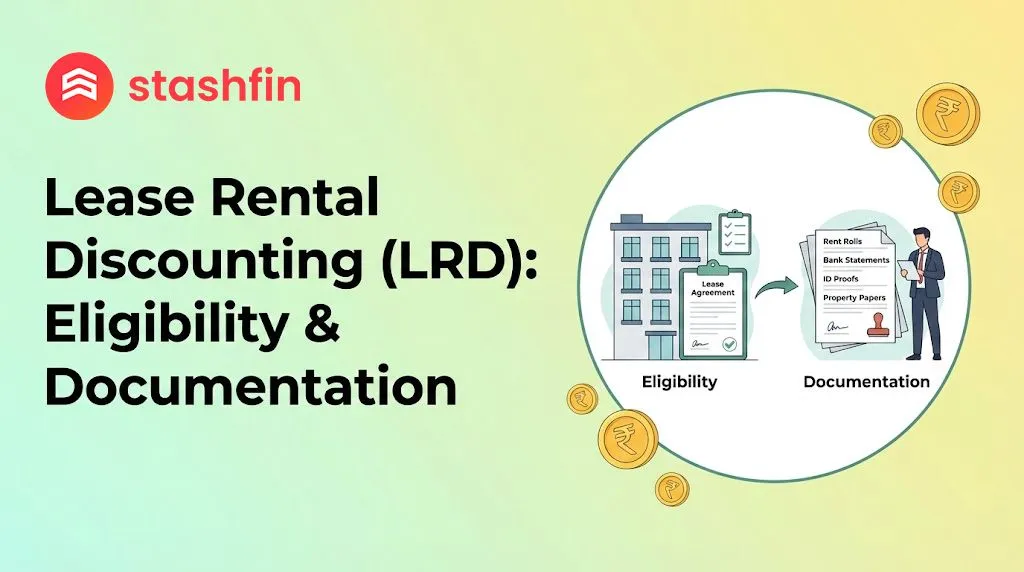
Lease Rental Discounting (LRD): Eligibility & Documentation
If you own a commercial property in India, you are sitting on a goldmine, and no, you don't have to sell it to strike gold. In the high-stakes world of real estate and business expansion, Lease Rental Discounting (LRD) has emerged as the most sophisticated tool for generating immediate liquidity.

Unlike a traditional loan that looks at your personal salary or business turnover, LRD focuses on the rent your property earns. It is essentially a way to "fast-forward" your future rental income into a lump sum today.
This guide breaks down exactly how LRD works in 2026, the strict eligibility criteria lenders look for, and the exhaustive documentation you’ll need to secure the best rates.
What is Lease Rental Discounting (LRD)?
At its core, Lease Rental Discounting is a term loan offered by banks and NBFCs against the rental receipts derived from lease contracts with corporate tenants.
The logic is simple: If you have a 10-year lease agreement with a reputable MNC that pays you ₹5 Lakhs a month, a bank sees that as a "guaranteed" future cash flow. They "discount" the total value of those future payments to their present value and hand you that amount today.
LRD Eligibility Criteria: Do You Qualify?
Lenders are highly selective with LRD because the loan's repayment depends almost entirely on the tenant’s ability to pay rent. In 2026, banks have tightened these parameters to ensure stability.
The Tenant Profile (The Counterparty Risk)
This is the most critical factor. Banks rarely offer LRD for properties leased to small, unorganized businesses or individuals. They prefer "Grade A" tenants, including:
- Multi-National Corporations (MNCs)
- Public Sector Undertakings (PSUs) & Government Bodies
- Scheduled Commercial Banks
- Large-cap or Reputed Mid-cap Private Limited Companies
Property Type and Location
The property must be "ready-to-move" (no under-construction LRD). It typically must be a:
- Commercial Office Space
- Retail Space/Malls
- Industrial Warehouse or Logistics Park
- Specialised Real Estate (Hospitals/Schools)
Lease Tenure and Lock-in Period
Lenders typically look for a minimum unexpired lease period of 3 to 5 years. If your lease expires in 12 months, a bank will not grant a 10-year loan. The loan tenure is strictly pegged to the lease validity.
Financial Ratios: LTV and DSCR
- Loan-to-Value (LTV): Usually capped at 60% to 75% of the property's market value.
- Debt Service Coverage Ratio (DSCR): Banks want to see that your rental income is significantly higher than the EMI. A DSCR of 1.2 to 1.5 is the industry standard (meaning your rent should be 20-50% higher than the monthly loan repayment).
Mandatory Documents for LRD
Documentation for LRD is extensive because the bank is evaluating three entities: You (the owner), the Property, and the Tenant.
Individual / Business KYC
- PAN Card (Mandatory for all applicants and co-applicants).
- Address Proof: Aadhaar Card, Passport, or Voter ID.
- Business Proof: Incorporation Certificate, Partnership Deed, or MOA/AOA (for non-individual owners).
Property Documents
- Title Deeds: Clear, marketable title deeds showing the entire chain of ownership.
- Approved Sanction Plan: Copy of the building plan approved by local authorities.
- Occupation Certificate (OC): To prove the building is legally habitable.
- Latest Property Tax Receipts.
Lease Specific Documents (The Heart of LRD)
- Registered Lease Deed: An unregistered agreement is usually rejected.
- Letter of Attornment: A document from the tenant acknowledging the loan and agreeing to pay rent into the bank's Escrow Account.
- Tenant Profile: Company profile and, in some cases, the last 3 years' financials of the tenant.
Financial Documents
- Bank Statements: Last 12 months' statements of the account where rent is currently credited.
- Income Tax Returns: Last 3 years of ITR with computation, P&L, and Balance Sheet (Audited by a CA).
- Existing Loan Details: Sanction letters and repayment tracks of any other active loans.
LRD vs. Loan Against Property (LAP): A Comparison
Many property owners confuse LRD with a standard Loan Against Property (LAP). While both use property as collateral, the underwriting logic is completely different.
| Feature | Lease Rental Discounting (LRD) | Loan Against Property (LAP) |
|---|---|---|
| Primary Repayment Source | Rental Income from Tenant | Borrower's Personal/Business Income |
| Eligibility Focus | Tenant’s creditworthiness | Borrower's creditworthiness |
| Interest Rates (2026) | Lower (Starting ~8.3% - 9.5%) | Higher (Starting ~9.5% - 13%) |
| Loan Tenure | Tied to lease term (Up to 15 years) | Up to 15-20 years |
| Repayment Structure | Escrow account (Rent goes to bank) | Direct EMI from borrower's account |
Benefits of Lease Rental Discounting
- Cost Efficiency: Since the loan is "self-liquidating" (the tenant pays it off), the interest rates are significantly lower than unsecured business loans.
- Retained Ownership: You get a massive lump sum of cash while still retaining 100% ownership of the property and its future capital appreciation.
- No Personal Liability Pressure: As long as the tenant is stable, your personal cash flow remains untouched.
- Higher Loan Quantum: LRD often allows for higher loan amounts than what a bank would offer based solely on your ITR, as it leverages the strength of the corporate tenant.
The Bottom Line
Lease Rental Discounting is a high-efficiency financial product for those who have invested in high-quality commercial real estate. By shifting the "repayment burden" onto a corporate tenant, you unlock capital that can be used for further expansion, debt consolidation, or new asset acquisition.


