





















 Back
Back
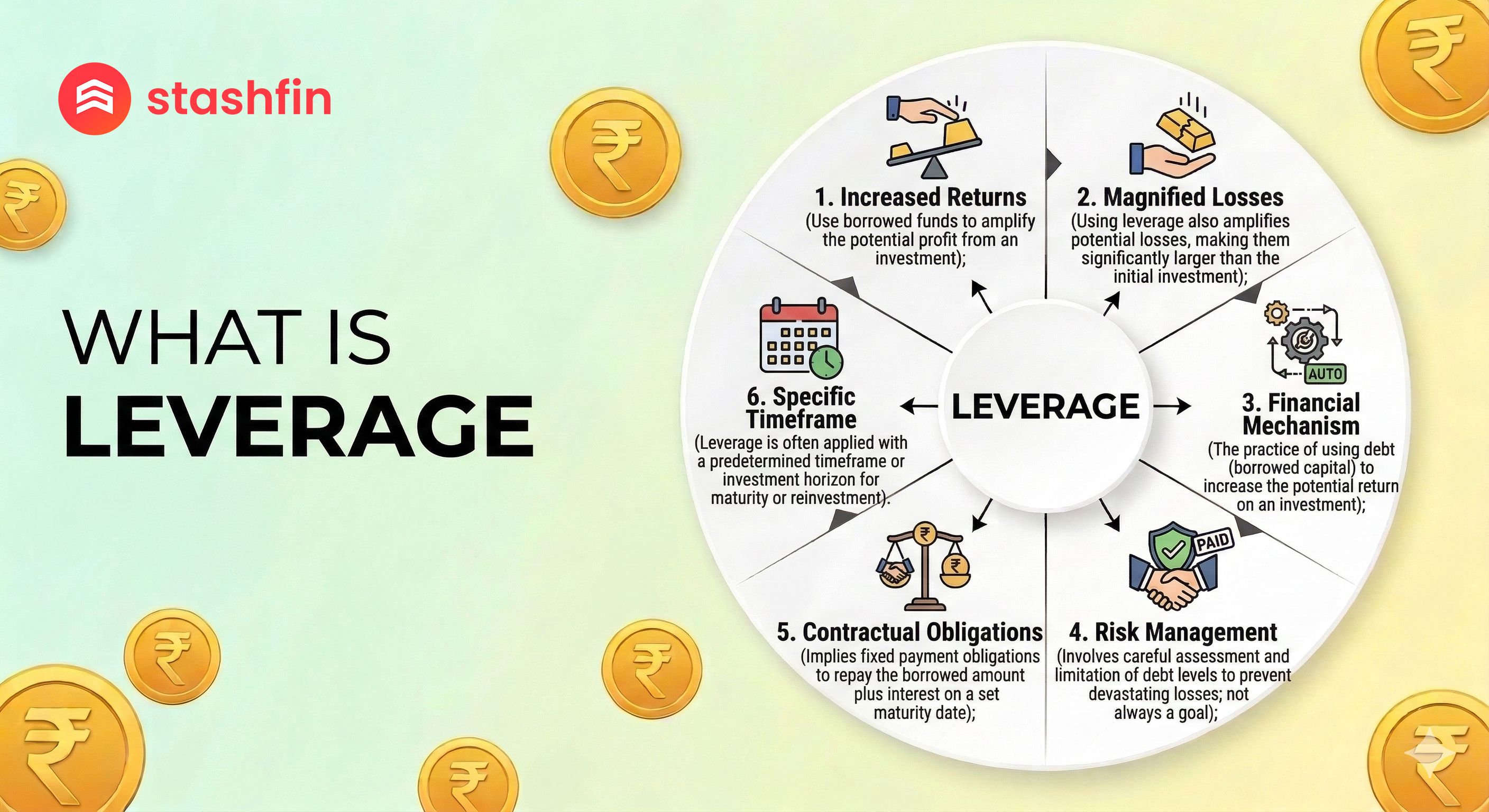

What is Leverage? Your 2026 Guide to Using Debt Strategically
In the simplest terms, leverage is the use of borrowed funds (debt) to increase the potential return on an investment. The concept is named after the lever in physics, a tool that allows a small amount of force to move a much larger object. In finance, leverage allows a small amount of your own capital to control a much larger asset.


Whether you are a salaried professional using a Stashfin Personal Loan to fund a professional certification or a business owner using credit to stock up before a festive sale, you are using leverage. You are betting that the "output" (your career growth or business profit) will be significantly higher than the "input" (the interest cost of the loan).
How Leverage Works: The Magnifying Effect
To understand leverage, you must understand its "multiplier" effect. When you use leverage, you aren't just spending money; you are amplifying your buying power.
A Practical Example:
Imagine you want to invest in a property worth ₹50 Lakh.
- Without Leverage: You wait years to save the full ₹50 Lakh. If the property price rises by 10% (₹5 Lakh), your total return on your invested capital is 10%.
- With Leverage (A Mortgage): You pay ₹10 Lakh (20%) from your savings and borrow ₹40 Lakh. If the property price rises by the same 10% (₹5 Lakh), that profit belongs entirely to you. Your ₹5 Lakh gain on a ₹10 Lakh investment is now a 50% return.
The Three Main Types of Leverage
In 2026, leverage appears in various forms depending on who is using it and for what purpose.
I. Financial Leverage
This is the most common form, where individuals or companies borrow money to purchase assets. For a Stashfin user, this might mean taking an Instant Credit Line to buy a high-end laptop for a freelance business. You use the laptop to generate income that far exceeds the monthly EMI.
II. Operating Leverage
Used primarily by businesses, this involves using "fixed costs" (like automated machinery or software subscriptions) to increase returns. High operating leverage means that once you cover your fixed costs, every additional sale results in a massive jump in profit.
III. Combined Leverage
This is the "Total Risk" view. It looks at how a company's (or an individual's) total debt and fixed operational costs work together. Managing combined leverage is the key to long-term financial stability.
Leverage in Personal Finance: Good Debt vs. Bad Debt
Not all leverage is created equal. In 2026, the distinction between "Good Debt" and "Bad Debt" is the cornerstone of a healthy credit profile.
- Good Leverage: Borrowing for things that grow in value or generate income. Examples include home loans, education loans, or business expansion loans. These are investments in your future self.
- Bad Leverage: Borrowing for depreciating assets or non-essential consumption without a plan. While a Stashfin Personal Loan is flexible, using it for a vacation you can't afford is "consumption," not "leverage."
The Risks: A Double-Edged Sword
While leverage magnifies gains, it equally magnifies losses. This is why financial experts often call leverage a "double-edged sword."
- Interest Burden: You must pay the interest regardless of whether your investment succeeds. If your "leveraged" business venture fails, you still owe the principal plus interest.
- Margin Calls: In the stock market, if the value of your leveraged investment drops below a certain point, the lender (broker) may demand more money instantly or sell your assets at a loss.
- Over-leveraging: Taking on more debt than your cash flow can support. In 2026, lenders look closely at your Debt-to-Income (DTI) ratio. Keeping this below 40% ensures you are using leverage, not being buried by it.
Key Leverage Ratios to Watch
If you are analyzing a company or your own finances, these three ratios are essential:
- Debt-to-Equity (D/E) Ratio: Measures how much debt is used relative to your own money.
- Interest Coverage Ratio: Determines how easily you can pay interest on your outstanding debt with your current earnings.
- Debt-to-Total Assets: Shows what percentage of your assets are actually "owned" by the bank or lender.
Conclusion
Leverage is a powerful fuel for the financial engine of 2026. When used with discipline and a clear strategy, it can accelerate your journey to homeownership, career success, and business growth. However, like any fuel, it must be handled with care. The goal isn't just to borrow, but to borrow for a purpose that yields a higher return than the cost of the credit.
Stashfin provides the "lever" with flexible, instant credit products while you provide the "force"—your vision and financial discipline.

