





















 Back
Back
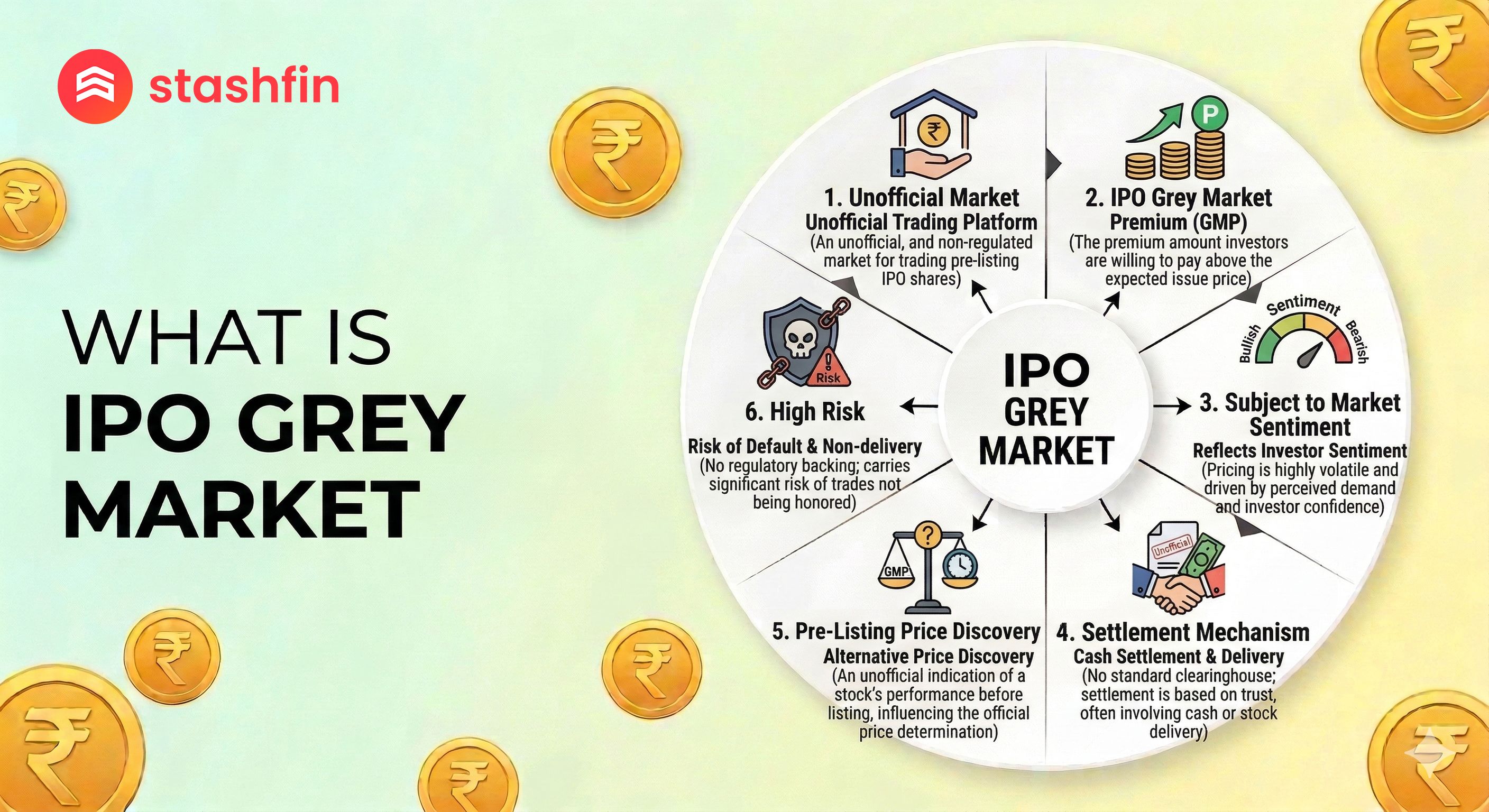

What is the IPO Grey Market?
The IPO Grey Market is an unofficial and unregulated over-the-counter (OTC) market where shares or IPO applications are traded before they are officially listed on a stock exchange like the NSE or BSE.


It is called a "grey" market because it is neither "white" (official and regulated) nor "black" (illegal). It operates in a legal grey area—it isn't banned by law, but it is not authorized or governed by the Securities and Exchange Board of India (SEBI). Transactions here are based entirely on mutual trust and the reputation of informal dealers.
This guide demystifies the unofficial trading world of IPOs, explaining key terms like GMP and Kostak Rate, and how investors use this data to predict listing day performance in 2026.
How the IPO Grey Market Works
The grey market typically becomes active the moment a company announces its IPO price band and dates. Trading continues until the day the shares are officially listed on the exchange.
- Informal Dealings: Transactions happen through a network of local dealers and brokers, often via phone calls or private messaging groups.
- Settlement: Since the shares aren't officially in the investor's account yet, the actual settlement (exchange of money and shares) happens only after the listing.
- Two Types of Trading:
- Trading IPO Shares: Investors buy or sell the actual shares they expect to be allotted.
- Trading IPO Applications: Investors sell their entire application form for a fixed profit, regardless of whether they get an allotment.
Key Terms You Need to Know
If you’re following IPO news in 2026, you’ll frequently encounter these three terms:
A. Grey Market Premium (GMP)
GMP is the most followed metric. It is the additional amount (premium) that investors are willing to pay over and above the IPO issue price.
- The Formula: Expected Listing Price = Issue Price + GMP.
- Example: If an IPO is priced at ₹500 and the GMP is ₹150, the grey market expects the stock to list at ₹650.
B. Kostak Rate
The Kostak rate is the fixed amount a buyer pays for a full IPO application. This is a "sure-shot" profit for the seller. Even if the seller doesn't receive any shares in the allotment, the buyer must pay the agreed Kostak rate.
C. Subject to Sauda (SS)
This is a conditional version of the Kostak rate. Under "Subject to Sauda," the buyer only pays the premium if the seller actually receives an allotment of shares. If no shares are allotted, the deal is cancelled.
Why Do Investors Track the Grey Market?
In 2026, where data is king, the grey market serves as a powerful sentiment gauge:
- Price Discovery: It provides an early indication of demand. A soaring GMP often signals that the IPO will be oversubscribed and may see a "bumper" listing.
- Listing Strategy: If the GMP starts falling closer to the listing date, it might signal waning interest, prompting retail investors to reconsider their "exit" strategy.
- Arbitrage Opportunities: Experienced traders use the grey market to lock in profits before the stock even hits the exchange.
The Risks Involved
While the data is useful, the grey market is not for the faint of heart:
- No Legal Recourse: If a dealer or counterparty backs out of a deal, you cannot complain to SEBI or the police. The market runs purely on trust.
- Manipulation: Since it is unregulated, big players can sometimes artificially inflate the GMP to create "hype" and lure retail investors into a weak IPO.
- Counterparty Risk: In volatile markets, if a stock lists at a massive discount (below the issue price), the buyer in the grey market might vanish, leaving the seller with the loss.
Comparison: Grey Market vs. Main Market
| Feature | IPO Grey Market | Main Market (NSE/BSE) |
|---|---|---|
| Regulation | Unregulated | SEBI Regulated |
| Trading Platform | Unofficial Dealer Networks | Recognized Stock Exchanges |
| Pricing | Demand/Supply Speculation | Transparent Bidding & Market Forces |
| Settlement | Trust-based (Post Listing) | Clearing House (T+1 Cycle) |
| Transparency | Low | High |
Conclusion
The IPO Grey Market is a fascinating, high-stakes mirror of investor sentiment. In 2026, it remains a vital tool for gauging the "buzz" around a new issue. However, at Stashfin, we always recommend that your investment decisions should be based on a company's fundamentals, its financials, management, and growth potential, rather than just the GMP.
Treat the grey market as a signal, not a guarantee. Use it to inform your strategy, but always keep your primary focus on regulated, safe, and researched investment paths.

