





















 Back
Back
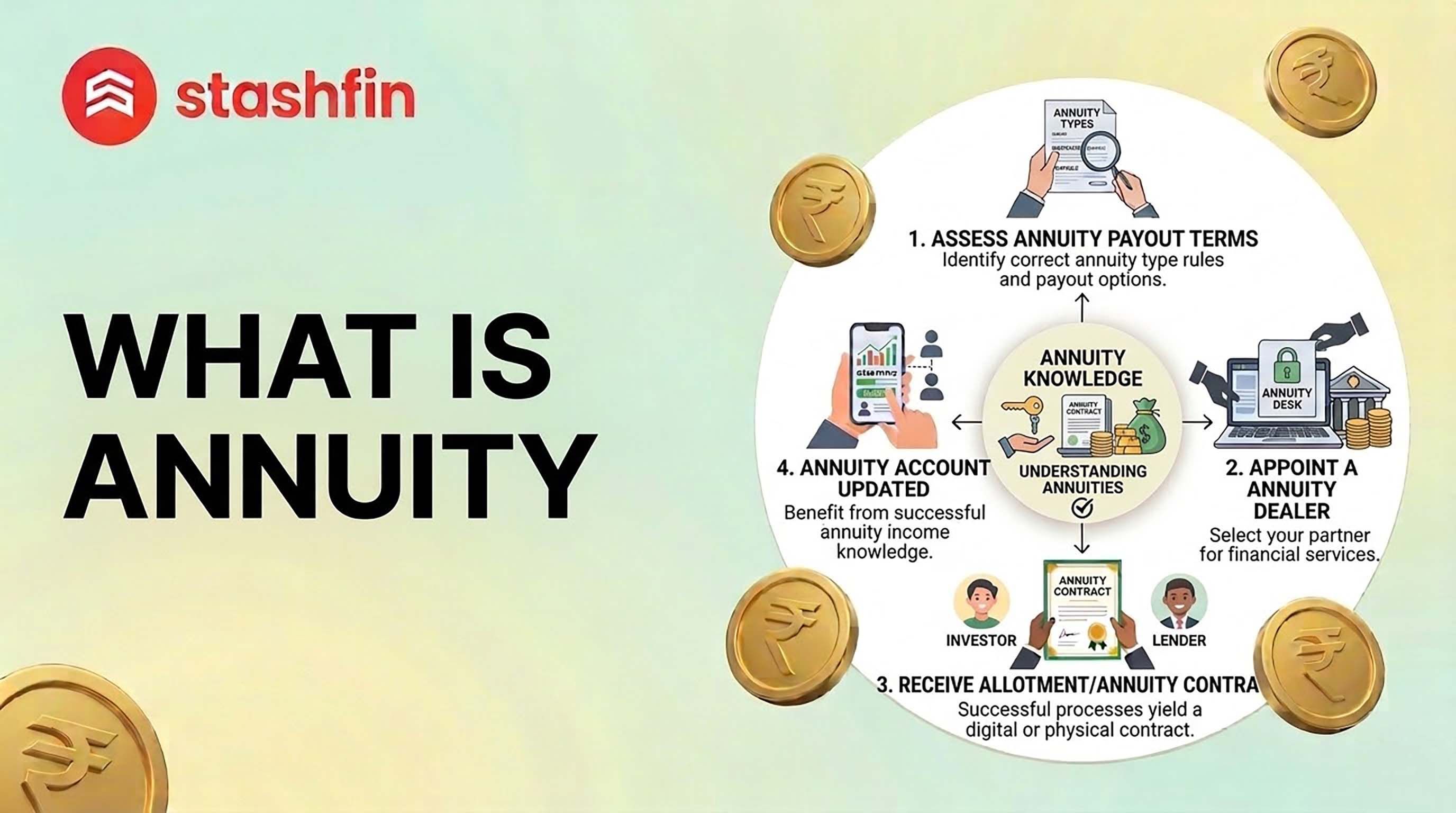

What is Annuity? The Modern Guide to Guaranteed Income
An Annuity is a long-term financial contract between an individual and an insurance company. In exchange for a lump-sum payment (or a series of payments), the insurer promises to make periodic payments to you, either immediately or at some point in the future.


Essentially, an annuity is a reverse insurance policy. While standard life insurance protects your family if you die too soon, an annuity protects you if you live "too long," ensuring you never outlive your money.
This comprehensive 2026 guide demystifies annuities as a retirement tool. Learn about the different types—Fixed, Variable, Immediate, and Deferred—understand the tax implications in India, and discover how to transform a lump sum into a lifelong monthly paycheck.
How an Annuity Works: The Two Phases
To understand an annuity, you must view it as a journey with two distinct stages:
A. The Accumulation Phase
During this period, you pay into the annuity. If it’s a Deferred Annuity, your money grows tax-deferred. You can invest a large lump sum all at once (Single Premium) or contribute smaller amounts over time (Flexible Premium).
B. The Annuitization (Distribution) Phase
This is when the "magic" happens. The insurance company converts your accumulated fund into a stream of regular payments. You can choose to receive these payments monthly, quarterly, or annually for a fixed number of years or for the rest of your life.
Key Types of Annuities in 2026
In the Indian market, annuities are tailored to suit different risk appetites and timing needs.
I. Based on Timing: Immediate vs. Deferred
- Immediate Annuity: You pay a lump sum, and the payouts start almost instantly (within 30 days). This is ideal for someone who has just retired.
- Deferred Annuity: You invest now, let the money grow, and specify a future date (e.g., 10 years later) for the payouts to begin.
II. Based on Payout: Fixed vs. Variable
- Fixed Annuity: The insurer guarantees a specific interest rate and payout amount. It is safe, predictable, and unaffected by market crashes.
- Variable Annuity: Your money is invested in market-linked instruments (like stocks or bonds). Your payouts can increase if the market does well, but they can also decrease if the market dips.
III. Based on Duration: Life vs. Term Certain
- Life Annuity: Payments continue for as long as you live.
- Joint Life: Payments continue as long as either you or your spouse is alive.
- Annuity Certain: Payments are guaranteed for a specific period (e.g., 15 years), regardless of whether you are alive or not.
Annuity Payout Options: Choosing Your Stream
When you reach the distribution phase, you have several choices on how you want your money back:
- Life Annuity without Return of Purchase Price: You get the highest monthly payout, but the payments stop when you pass away, and the insurer keeps the principal.
- Life Annuity with Return of Purchase Price (ROP): You get a slightly lower monthly payout, but when you pass away, the original lump sum you invested is returned to your nominees.
- Inflation-Indexed Annuity: The payout amount increases by a fixed percentage (e.g., 3% per year) to help you keep up with the rising cost of living in 2026.
The Pros and Cons of Annuities
| Benefits | Drawbacks |
|---|---|
| Guaranteed Lifetime Income: No risk of outliving your savings. | Illiquidity: Once you "annuitize," you usually cannot get your lump sum back for emergencies. |
| Tax-Deferred Growth: You don't pay tax on earnings until you withdraw them. | Inflation Risk: Fixed annuities might lose purchasing power over 20-30 years. |
| No Investment Management: The insurer handles the complex math and market risks. | Taxation: In India, annuity payouts are considered "Income" and taxed at your slab rate. |
Annuities in the Indian Context (2026)
In India, annuities are often the mandatory "exit route" for the National Pension System (NPS). When you turn 60, you must use at least 40% of your NPS corpus to buy an annuity. Popular providers in 2026 include LIC, HDFC Life, and SBI Life, offering various "Pension Plans" that are essentially deferred annuities.
Conclusion
An annuity is the ultimate "peace of mind" investment. It transforms the uncertainty of the stock market into the certainty of a monthly paycheck. In 2026, as life expectancy continues to rise, having a portion of your wealth "pensionized" through an annuity is not just a luxury—it’s a necessity for a dignified retirement.
While you work toward building your retirement corpus and selecting the right annuity, Stashfin’s Instant Credit Line ensures you have the liquidity to handle today's needs without dipping into your long-term future.

