





















 Back
Back
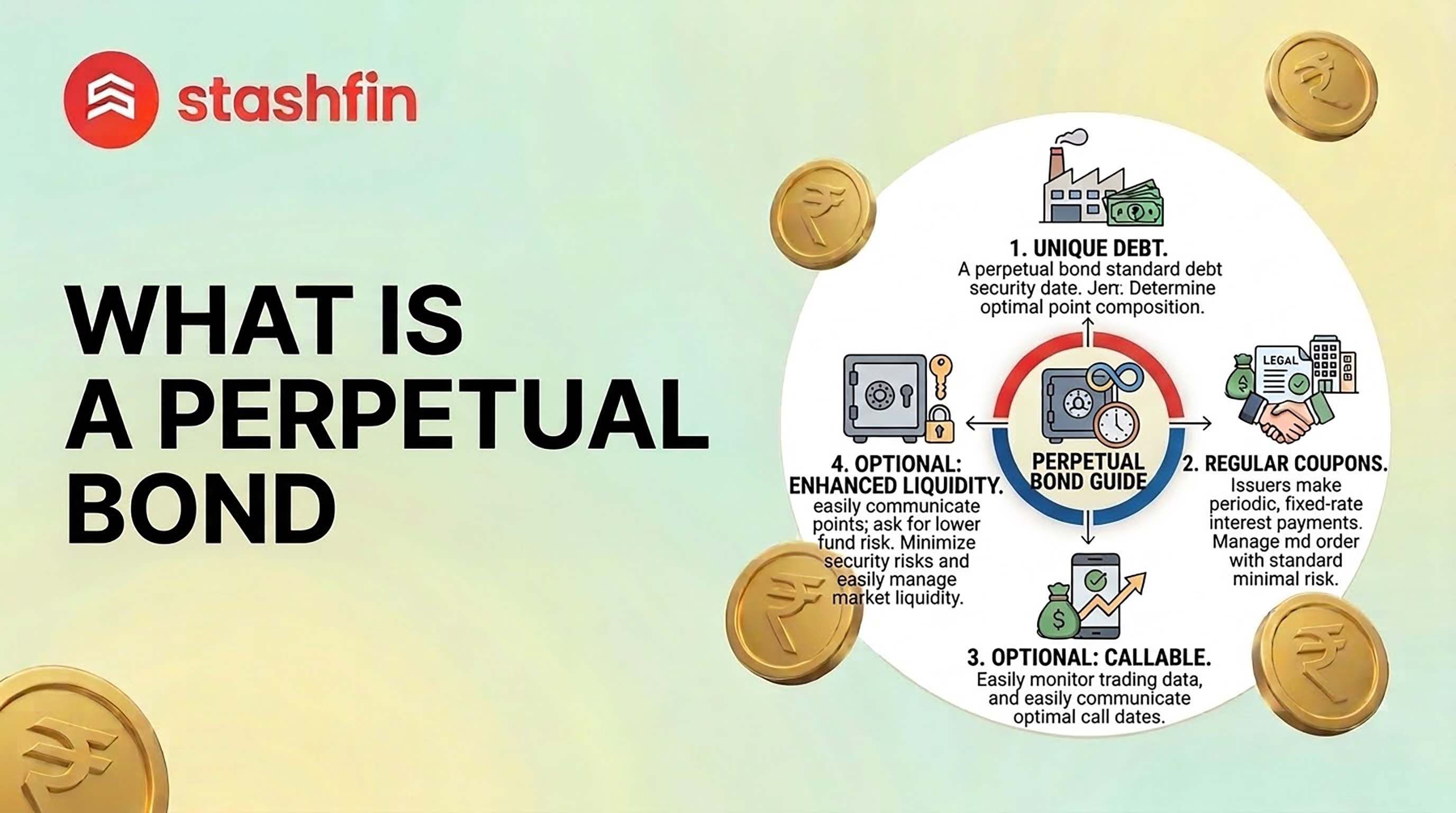

What Is a Perpetual Bond?
A Perpetual Bond (also known as a "Perp" or Consol) is a fixed-income security that has no maturity date. Unlike a standard bond where you get your principal back after 5 or 10 years, the issuer of a perpetual bond is not legally obligated to ever repay the principal amount to the investor. Instead, the issuer promises to pay a steady stream of interest (coupons) forever, or for as long as the organization exists.


This 2026 guide explores the world of Perpetual Bonds and Additional Tier-1 (AT1) bonds in India. Discover how these "forever bonds" work, why banks use them to shore up capital, the calculation of their yields, and the essential risks—from call options to interest deferral—that every investor must know.
How Perpetual Bonds Work: The "Hybrid" Nature
Perpetual bonds are often called "hybrid" instruments because they sit right on the fence between debt and equity.
- Like Debt: They pay a fixed interest rate (coupon) at regular intervals (usually annually).
- Like Equity: There is no fixed date to get your money back, and in the hierarchy of payments, perpetual bondholders are often just one step above equity shareholders.
In India, these are most commonly issued as Additional Tier-1 (AT1) Bonds by major banks like SBI, HDFC, and ICICI to meet global regulatory standards (Basel III norms).
Key Features of Perpetual Bonds in 2026
To master this asset class, you need to understand the unique "bells and whistles" attached to these bonds:
A. The Call Option (The Only Way Out)
While the bond doesn't "mature," almost all perpetual bonds come with a Call Option. This allows the issuer (the bank or company) to buy back the bond and return your principal after a certain period—typically 5 or 10 years.
Note: The "Call" is at the discretion of the issuer. You, as an investor, cannot force them to pay you back.
B. Higher Coupon Rates
Because you are taking on higher risk and sitting lower in the payment priority list, perpetual bonds offer significantly higher interest rates than regular bonds. In 2026, yields on AT1 bonds from top-tier Indian banks typically range between 7.9% and 9.5%, depending on the credit rating and market conditions.
C. Interest Deferral & Write-Downs
For bank-issued AT1 bonds, the issuer has the right to skip or defer interest payments if their capital levels fall below a certain threshold. Under extreme financial stress, the RBI can even mandate a "write-down" where the principal value is reduced to zero to save the bank.
Calculating the Yield: Why Price Matters
Since there is no maturity date, we don't use "Yield to Maturity" (YTM). Instead, we look at the Current Yield. Many perpetual bonds are traded on the secondary market (NSE/BSE).
$$\text{Current Yield} = \left( \frac{\text{Annual Coupon Payment}}{\text{Current Market Price}} \right) \times 100$$
If you buy a bond at a "discount" (less than its ₹10 Lakh face value), your effective yield will be higher than the promised coupon rate.
Perpetual Bonds vs. Regular Bonds
| Feature | Perpetual Bonds (AT1) | Regular Bonds |
|---|---|---|
| Maturity | No Maturity | Fixed Maturity (e.g., 5 years) |
| Principal Repayment | Only if "Called" by issuer | Guaranteed at maturity |
| Interest Rate | Higher (Premium for risk) | Lower (Market standard) |
| Issuer Flexibility | Can skip interest (conditions apply) | Must pay or face default |
| Risk Level | High (Quasi-equity) | Low to Moderate |
Taxation: What Stays in Your Pocket?
In India, the taxation of perpetual bonds in 2026 follows standard debt instrument rules:
- Interest Income: The annual coupon is added to your total income and taxed according to your Income Tax Slab.
- Capital Gains: If you sell the bond on the stock exchange after holding it for more than 12 months, the gains are taxed as Long-Term Capital Gains (LTCG) at 12.5% (without indexation). If sold earlier, they are taxed at your slab rate.
Conclusion
Perpetual bonds are the "marathon runners" of the investment world. They offer an attractive, high-interest income stream that can theoretically last for generations. However, they are not a "set it and forget it" investment like a fixed deposit. They require a close eye on the financial health of the issuer and a tolerance for price volatility.
At Stashfin, we believe in a balanced financial life. While you build your "forever" income stream through perpetual bonds or Akara Capital bonds (offering up to 14.5% p.a.) on Stashfin, our Instant Credit Line is here to ensure your today is as secure as your tomorrow.

