





















 Back
Back
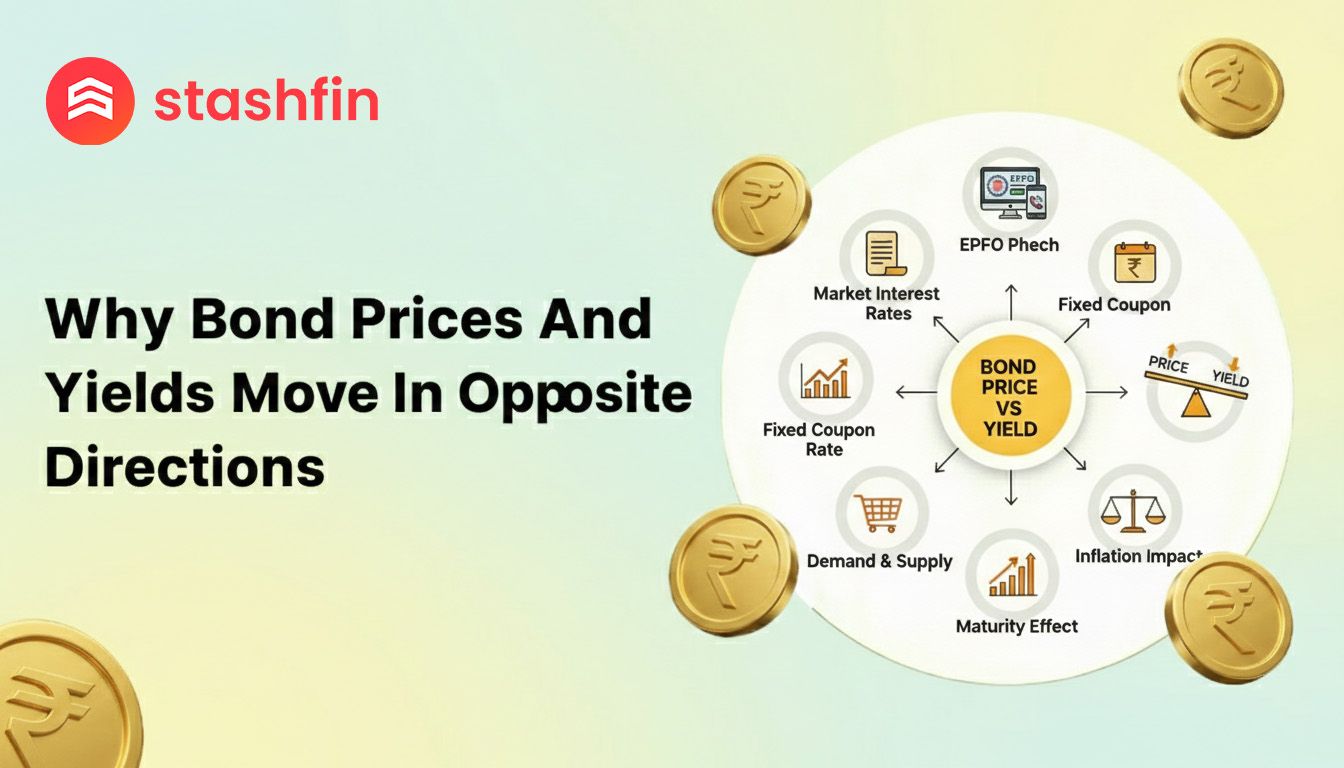

The Bond Market Seesaw: Why Prices and Yields Move in Opposite Directions
You turn on the financial news, and a frantic anchor announces that "bond yields are surging." A few seconds later, they note that "bond prices are tumbling."


It sounds like a total paradox. How can the yield—which sounds like your profit—go up while the price goes down? It’s one of the most confusing concepts in finance, but it’s actually driven by simple common sense.
To understand it, you just need to picture a playground seesaw. When one side goes up, the other side is mathematically forced to go down.
The Fixed Reality of a Bond
Before you can understand the seesaw, you have to understand what a bond actually is. It’s simply an IOU.
When you buy a newly issued bond, you are locking in a specific interest rate (called the coupon) that will never change. If you buy a ₹10,000 bond that pays 5% a year, it will pay you exactly ₹500 every single year until the bond matures.
That ₹500 is written in stone. It does not care what the stock market is doing, and it doesn't care what the central bank announces on a Tuesday. The cash payout is fixed.
The Seesaw in Action: A Real-World Example
The confusion starts when you decide you don't want to hold that bond for ten years. You want to sell it to someone else today.
Scenario A: Interest Rates Go Up (Your Bond is "On Sale")
Fast forward one year. The Reserve Bank of India (RBI) hikes interest rates to fight inflation. Now, brand new bonds are hitting the market paying an attractive 7%.
You want to sell your old 5% bond, but you have a problem: Why would any investor buy your bond paying ₹500 a year when they could buy a brand new one paying ₹700?
They won't—unless you put your bond on sale. To convince a buyer, you drop the price from ₹10,000 down to ₹9,500. Because the buyer pays less upfront but still gets the fixed ₹500 payout, their actual return—the yield—effectively goes up.
The Result: Interest rates rose → Bond prices fell → Yields went up.
Scenario B: Interest Rates Go Down (Your Bond is a "Premium Catch")
Imagine the RBI drops interest rates to 3%. Suddenly, your old bond paying 5% looks like a goldmine. Because demand is high, you can sell your ₹10,000 bond for a premium—maybe ₹10,800.
Because the new buyer paid more to get that interest rate, their effective return shrinks.
The Result: Interest rates fell → Bond prices rose → Yields went down.
Coupon Rate vs. Yield: What’s the Difference?
| Feature | Coupon Rate | Current Yield |
|---|---|---|
| Definition | The fixed interest percentage printed on the bond. | The actual return based on the current market price. |
| Flexibility | Static (Never changes). | Dynamic (Changes every second). |
| Calculation | Based on the Face Value (₹10,000). | Based on the Market Price (e.g., ₹9,500). |
Does This Matter if I Hold Until Maturity?
Not really. If you buy that ₹10,000 bond and hold it until the very last day, you will get your fixed ₹500 every year and your ₹10,000 back. You can completely ignore the seesaw.
However, it matters for Debt Mutual Funds:
Fund managers are constantly buying and selling bonds. When interest rates rise, the value of the older bonds inside the mutual fund drops. This is why your "safe" debt fund can occasionally show a negative return on your dashboard.

