





















 Back
Back
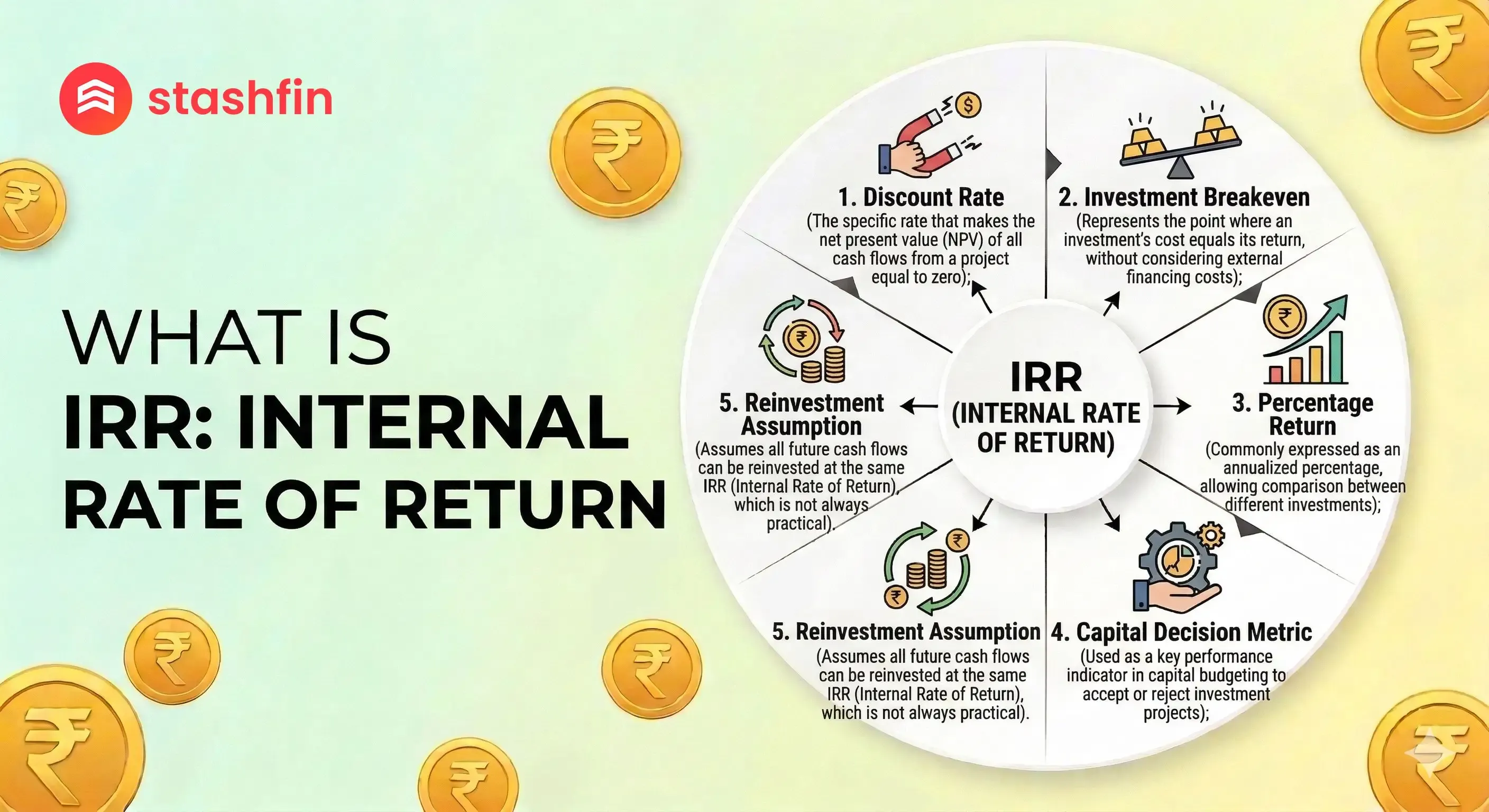

What Is IRR (Internal Rate of Return)?
The Internal Rate of Return (IRR) is a financial metric used to estimate the profitability of potential investments or the "true cost" of a loan. Technically, it is the discount rate that makes the Net Present Value (NPV) of all cash flows (both positive and negative) from a project or investment equal to zero.


In simpler terms, IRR represents the annualized growth rate of an investment, accounting for the time value of money. It tells you the exact percentage rate your money is earning (or costing you) while it is "inside" the investment or loan.
How IRR Works: The Time Value of Money
The most critical difference between IRR and simple interest is that IRR recognizes that ₹1 today is worth more than ₹1 tomorrow.
- For Investors: IRR helps you understand the compounded return on your capital, especially when you receive payouts at different times (like a SIP or a multi-year business project).
- For Borrowers: When you take a personal loan, you aren't just paying back the principal; you are paying it back in installments over time. IRR calculates the "effective" interest rate you are paying by considering the exact dates of your EMIs and any upfront fees.
IRR vs. ROI: What’s the Difference?
Many people use these terms interchangeably, but they serve different purposes.
| Feature | Return on Investment (ROI) | Internal Rate of Return (IRR) |
|---|---|---|
| Focus | Total growth from start to finish. | Annualized efficiency of capital. |
| Time Factor | Ignores the duration of the investment. | Fully accounts for the timing of cash flows. |
| Complexity | Simple (Profit / Cost). | Complex (Requires DCF analysis). |
| Best For... | Short-term or one-time gains. | Multi-year projects or EMI-based loans. |
Why IRR Matters for Stashfin Users
At Stashfin, we prioritize transparency. When you see our interest rates starting from 11.99% p.a., that is the base rate. However, when you include processing fees or insurance, the IRR (or Effective Interest Rate) might be slightly higher.
Why you should care about IRR:
- True Cost Discovery: It helps you see the impact of upfront processing fees. A loan with a lower interest rate but a very high processing fee might actually have a higher IRR than a slightly higher interest loan with zero fees.
- Comparing Offers: If you have two loan offers with different tenures (e.g., 12 months vs. 36 months), IRR allows you to compare them on a "level playing field."
- Investment Decisions: If you are using your Stashfin Credit Line to fund a business venture, knowing your project’s IRR ensures it is higher than the loan’s interest rate, guaranteeing you stay profitable.
Conclusion
The Internal Rate of Return (IRR) is the "X-ray" of financial metrics; it looks past the surface numbers to show you the real skeletal structure of a deal. In 2026, where every rupee counts, being able to distinguish between a "good deal" and a "mathematically sound deal" is a superpower.
By understanding IRR, you can better manage your Credit Line, plan your repayments, and ensure that every financial move you make is optimized for your long-term wealth.

