


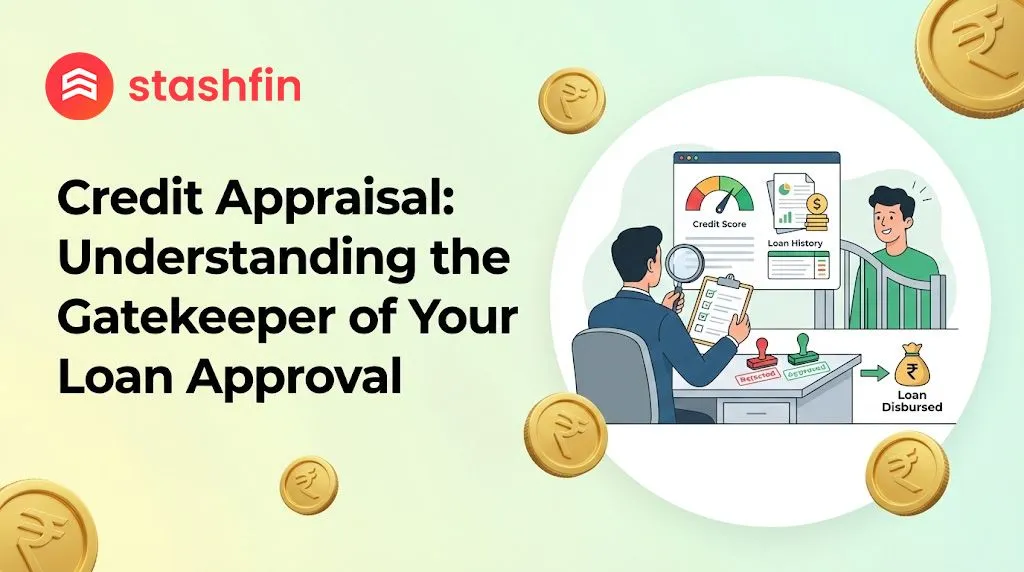
Credit Appraisal: Understanding the Gatekeeper of Your Loan Approval
Have you ever wondered what happens after you hit "Submit" on a loan application? Whether it is for a ₹50,000 instant credit line or a ₹5 Crore home loan, your application enters a sophisticated, high-stakes evaluation phase known as Credit Appraisal.
In the financial landscape of 2026, credit appraisal is no longer just a manual review of your bank statements. It is an intricate blend of data science, traditional risk assessment, and behavioral analysis. It is the process lenders use to determine one thing: Will you pay them back?
This guide provides a deep dive into the mechanics of credit appraisal, the "5 Cs" that lenders live by, and how you can optimize your profile to ensure a seamless approval.

What is Credit Appraisal?
Credit Appraisal is the comprehensive process by which a lender (bank, NBFC, or fintech) assesses the eligibility and creditworthiness of a loan applicant. It is the stage where the "promise to pay" is tested against "the ability to pay."
The appraisal process doesn't just look at how much you earn; it looks at your financial discipline, the stability of your income, and your existing debt obligations. For the lender, this is a Risk Mitigation tool, it ensures that they aren't lending money to someone who is likely to default.
The "5 Cs" of Credit Appraisal
Lenders across the globe, including modern Indian institutions, use a framework known as the 5 Cs to build a 360-degree view of the borrower.
Character (The Integrity Test)
This is perhaps the most critical "C." It refers to your track record and reputation as a borrower. Lenders look at your Credit Bureau Report (CIBIL, Experian, etc.) to see if you have a history of paying on time. If you have "Character," you have demonstrated financial honesty.
Capacity (The Ability to Repay)
Can your current income support a new EMI? Lenders calculate your Fixed Obligation to Income Ratio (FOIR). If more than 40–50% of your income is already going toward existing loans, your "Capacity" for a new loan is considered low.
Capital (The Financial Stake)
Lenders want to see that you have "skin in the game." For a home loan, this is your down payment. For a business loan, it is the equity you’ve invested. The more capital you have, the more committed you are seen to be.
Collateral (The Security)
In secured loans, collateral acts as a backup. If you cannot repay the loan, the bank can seize the asset (like a house or car) to recover their money. In unsecured credit lines, lenders rely more heavily on "Character" and "Capacity" since there is no collateral.
Conditions (The External Factors)
Sometimes, your personal profile is perfect, but the "Conditions" aren't. This includes the state of the economy, the stability of your specific industry (e.g., hospitality vs. IT), and the purpose of the loan.
The Credit Appraisal Process: Step-by-Step
In 2026, the appraisal process for digital lenders like Stashfin takes minutes, while traditional banks may take days. Here is the standard workflow:
Step 1: Document Collection & Verification
The first step is gathering your KYC (Aadhaar, PAN), income proof (salary slips, ITR), and bank statements. Lenders use automated tools to verify the authenticity of these documents instantly.
Step 2: Credit Bureau Check
The lender "pulls" your report from one or more credit bureaus. They look for your score, any past defaults, and the number of recent credit inquiries you’ve made.
Step 3: Technical & Legal Appraisal (For Secured Loans)
If you are pledging a property, the lender sends experts to evaluate its market value (Technical) and lawyers to ensure the title deeds are clear of disputes (Legal).
Step 4: Income Analysis & FOIR Calculation
The credit manager (or an AI algorithm) analyzes your bank statement to look for "negative trends", such as cheque bounces, low average monthly balances, or frequent gambling transactions. They then calculate exactly how much EMI you can afford.
Step 5: Final Sanction or Rejection
Based on the cumulative score of the above steps, the lender decides the Loan Quantum, the Interest Rate, and the Tenure.
Financial Ratios Used in Credit Appraisal
If you want to pass an appraisal with flying colors, you need to understand the numbers lenders are crunching:
| Ratio | What it Means | Ideal Target |
|---|---|---|
| FOIR | Fixed Obligation to Income Ratio | Below 40% |
| LTV | Loan to Value (For secured loans) | 70% to 80% |
| DSCR | Debt Service Coverage Ratio (For Business) | 1.25 or Higher |
| Current Ratio | Current Assets vs. Current Liabilities | 2:1 |
How Modern Appraisal Differ: The Shift to "Alternative Data"
In 2026, credit appraisal has moved beyond just CIBIL scores. Modern fintechs now use Alternative Data to approve borrowers who might be "New-to-Credit." This includes:
- Utility Bill Payments: Consistent payment of electricity and phone bills.
- Professional Stability: Analysing LinkedIn profiles or employment vintage.
- Cash Flow Patterns: Looking at the frequency of credits in a digital wallet or bank account.
This shift toward Comprehensive Credit Reporting ensures that even if you don't have a 10-year loan history, your daily financial discipline can still win you an approval.
Common Reasons for Credit Appraisal Failure
Understanding why applications are rejected can help you prepare better:
- Low Credit Score: Usually the primary reason for rejection in unsecured loans.
- Unstable Employment: Switching jobs too frequently makes you look "risky" to a lender.
- Inadequate Income: If your salary doesn't meet the minimum threshold for the requested loan amount.
- Inconsistent Bank Statements: Frequent "minimum balance" penalties or bounced standing instructions.
- High Existing Debt: Being "over-leveraged" is a major red flag.
Tips to Improve Your Credit Appraisal Success
- Reduce Your Debt-to-Income Ratio: Pay off small, nagging debts (like credit card dues) before applying for a large loan.
- Maintain a Healthy Bank Balance: For at least six months before an application, ensure your bank account shows a steady "Average Monthly Balance."
- Avoid Multiple Inquiries: Don't apply at five different banks simultaneously. Each "Hard Inquiry" can slightly weaken your appraisal score.
- Be Honest: Never provide inflated income figures or falsified documents. Verification systems in 2026 are nearly impossible to fool.
Bridging your Financial Goals & Capital
Credit appraisal is the bridge between your financial goals and the capital needed to reach them. While it may seem like a hurdle, it is actually a protective measure for both the lender and the borrower, ensuring that the debt taken is sustainable.
By maintaining a clean credit history, managing your debt-to-income ratio, and understanding the "5 Cs," you can transform the appraisal process from a stressful wait into a guaranteed "Approved."
Check out the instant personal loan app by Stashfin on Android and Stashfin iOS app for quick approvals and easy access to funds.


