


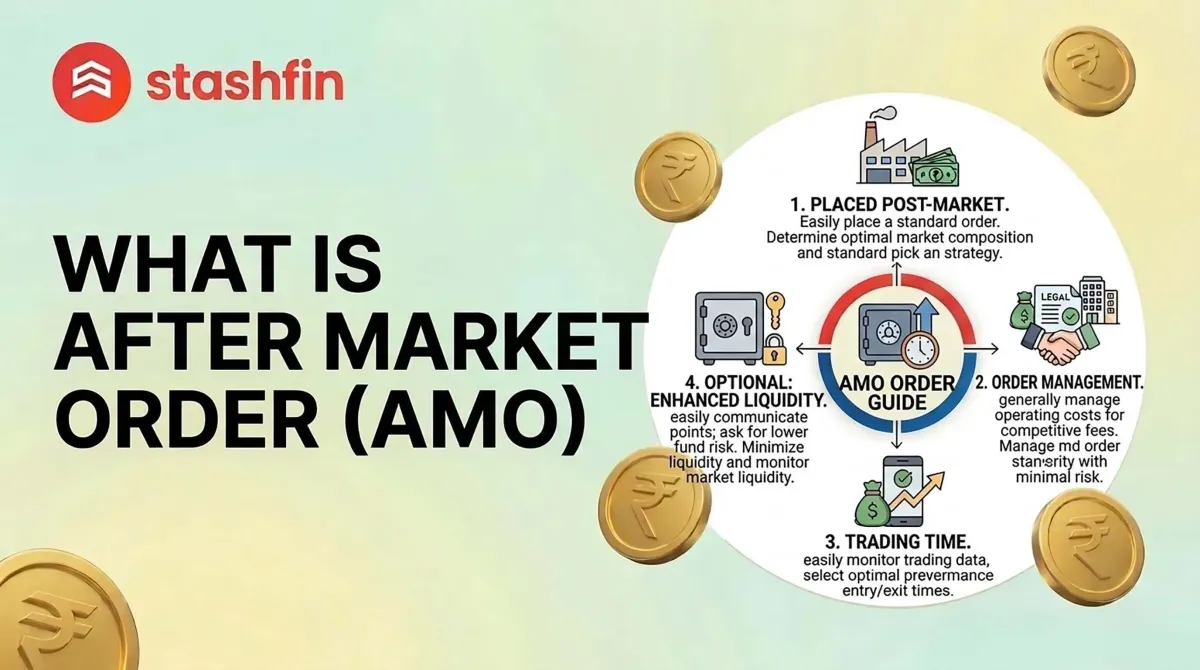
What Is After Market Order (AMO)?
An After Market Order (AMO) is a specialised order type that allows you to place buy or sell requests outside of regular exchange hours. Instead of waiting for the opening bell at 9:15 AM, you can enter your trade instructions the evening before or early in the morning. Your broker then "queues" these orders and sends them to the exchange as soon as the market reopens the next trading day.

This definitive 2026 guide explains the mechanics of After Market Orders (AMO) in the Indian stock market. Learn about AMO timings for NSE and BSE, the difference between market and limit AMOs, and how to strategically use after-hours trading to react to overnight global cues and corporate news.
How does an AMO Operate?
The life of an AMO is a three-stage journey that begins when the rest of the market is winding down.
- Step 1: Placement You place your order on your trading app (like Stashfin's partner platforms) anytime after the market closes.
- Step 2: Validation & Queueing The broker's system checks your margins and funds. If everything is in order, the request is stored in a dedicated AMO queue.
- Step 3: Execution At the start of the next trading day, usually during the Pre-open session (9:00 AM to 9:07 AM) or at the Normal Market Open (9:15 AM), the broker pushes your order to the exchange (NSE or BSE).
AMO Timings for Different Segments (2026 Update)
Timings can vary slightly between brokers, but the general windows for placing AMOs in India are as follows:
| Segment | AMO Window (General) | Execution Time |
|---|---|---|
| Equity (Cash) | 3:45 PM to 8:57 AM | 9:00 AM (Pre-open) |
| F&O (Derivatives) | 3:45 PM to 9:10 AM | 9:15 AM |
| Currency | 5:00 PM to 8:59 AM | 9:00 AM |
| Commodity (MCX) | 11:30 PM to 8:58 AM | 9:00 AM |
Note: Most brokers do not accept AMOs during the Post-market session (3:40 PM - 4:00 PM) or during scheduled system maintenance (usually between 1:00 AM and 5:00 AM).
Types of After Market Orders
When placing an AMO, you typically have two main choices. Choosing the right one is the difference between a successful trade and "price slippage."
A. AMO Limit Order (Recommended)
You specify the exact price at which you want to buy or sell.
- Why use it? It gives you total control. If you want to buy a stock at ₹500, the order only executes if the market price is ₹500 or lower at the open.
B. AMO Market Order
You don't specify a price; you tell the broker to buy or sell at whatever the best available price is when the market opens.
- Warning: In 2026, markets can "gap up" or "gap down" significantly due to overnight global news. A market order might execute at a much higher or lower price than the previous day's close.
Why Use AMO? The Strategic Advantages
- Convenience for Working Professionals: If your 9-to-5 job makes it impossible to track a screen during the day, AMOs let you invest on your own time.
- Reacting to Overnight News: If a company announces blockbuster earnings at 7:00 PM, you can place an AMO immediately to be first in line when the market opens.
- Disciplined Planning: Researching at night allows for a "cold-headed" analysis. You aren't influenced by the emotional volatility of live trading hours.
- First-Mover Advantage: Orders placed as AMOs are often processed during the pre-open session, potentially getting you the "Opening Price" before the retail rush at 9:15 AM.
Risks and Precautions
While AMOs offer flexibility, they aren't without "traps" for the unwary:
- Lower Liquidity: The first few minutes of the market can be erratic. If there aren't enough buyers/sellers, your order might stay pending.
- Price Gaps: A stock that closed at ₹100 yesterday might open at ₹110 today. If you placed a market buy AMO, you've already lost 10% of your potential gain.
- No Advanced Orders: Most brokers do not allow Bracket Orders (BO) or Cover Orders (CO) in the AMO window. Only simple Buy/Sell orders are permitted.
Conclusion
The After Market Order (AMO) is the ultimate tool for the "Calm Investor." It removes the stress of the 9:15 AM rush and allows you to execute your well-researched strategies on your own schedule. In 2026, as global markets become more interconnected, the ability to act on information while others are sleeping is a powerful competitive edge.
At Stashfin, we believe in helping you manage your financial life with precision. While you use an Instant Credit Line to bridge your immediate liquidity needs, using AMOs ensures your long-term investment engine never stops running, even when the exchanges are closed.


