


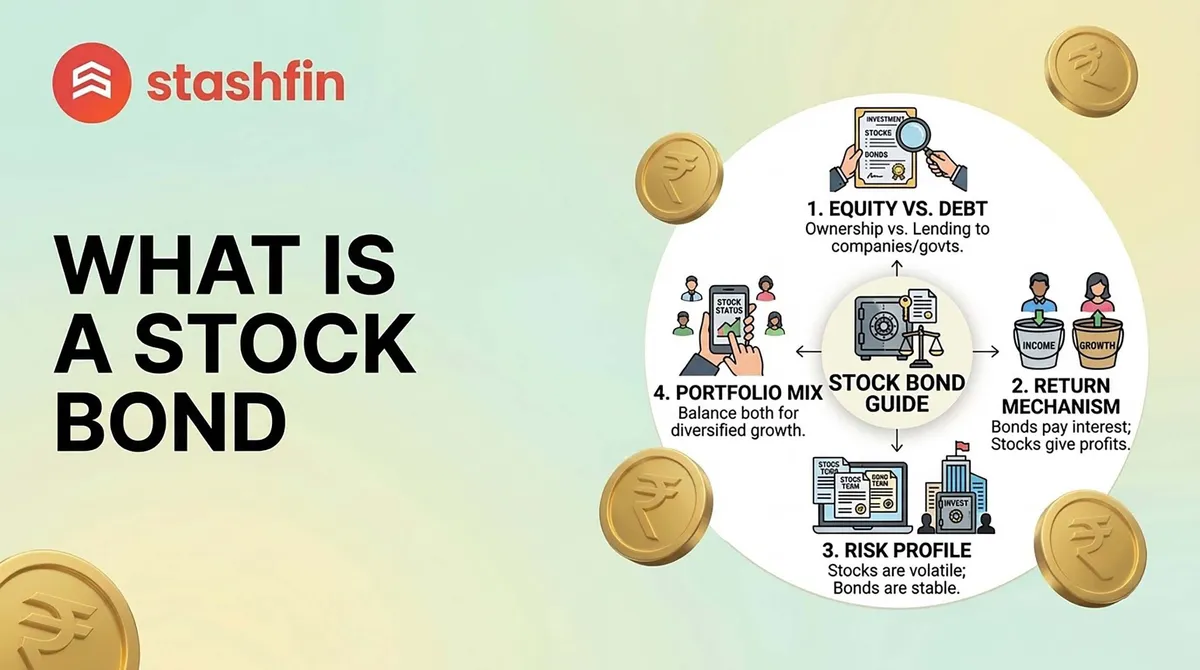
What is a "Stock Bond" Portfolio?
In the world of finance, there is no single instrument called a "Stock Bond." Instead, these are the two most fundamental pillars of a diversified portfolio.

- Stocks (Equity): Represent ownership. When you buy a stock, you own a piece of a company.
- Bonds (Debt): Represent lending. When you buy a bond, you are essentially giving a loan to a government or a corporation in exchange for interest.
This 2026 investor's guide demystifies the core differences between stocks and bonds in the Indian market. Learn how to balance ownership-driven growth with lending-driven stability, understand the impact of current interest rates on your yields, and discover the "magic ratio" for your age and risk appetite.
Stocks: The Growth Engine
In 2026, the Indian stock market continues to be a primary driver for wealth creation. When you buy shares of a company on the NSE or BSE, you are betting on that company's future success.
Key Features of Stocks:
- Ownership Rights: As a shareholder, you often get voting rights and a say in major company decisions.
- High Reward Potential: Stocks have no "ceiling." If a company grows 10x, your investment can grow 10x.
- Variable Returns: Returns come in two ways—Capital Gains (the stock price going up) and Dividends (a share of the company's profits).
- Volatility: Stock prices can swing wildly based on news, earnings, or global cues.
Bonds: The Stability Anchor
If stocks are the engine of your financial car, bonds are the brakes and the suspension. In 2026, the bond market in India has become highly accessible to retail investors through platforms like RBI Retail Direct.
Key Features of Bonds:
- Creditor Status: You are a lender, not an owner. The issuer is legally obligated to pay you back.
- Fixed Income: Most bonds pay a Coupon Rate (interest) at regular intervals (monthly, quarterly, or annually).
- Capital Preservation: Bonds are generally less volatile. At the end of the term (maturity), you get your original principal back.
- Priority in Payments: If a company goes bust, bondholders (creditors) are paid back before stockholders (owners).
Stocks vs. Bonds: A 2026 Comparison
| Feature | Stocks (Equity) | Bonds (Debt) |
|---|---|---|
| Your Role | Part-Owner | Lender/Creditor |
| Risk Level | High (Market Dependent) | Low to Moderate |
| Income Type | Dividends (Not Guaranteed) | Interest/Coupons (Guaranteed) |
| Growth Potential | Unlimited | Capped at Interest Rate |
| Best For | Long-term Wealth | Stable Income & Safety |
Why You Need Both: The Balanced Portfolio
In 2026, the "all or nothing" approach to investing is a recipe for stress. Diversification is the only "free lunch" in finance.
- During a Bull Market: Your stocks do the heavy lifting, increasing your net worth as the economy grows.
- During a Market Correction: Your bonds act as a cushion. While stocks might drop 20%, high-quality bonds often stay stable or even rise in value as investors seek safety.
The 2026 Rule of Thumb: A popular strategy is the "100 minus Age" rule. If you are 30 years old, you might keep 70% in stocks for growth and 30% in bonds for stability. As you get older, you gradually shift more toward the safety of bonds.
Types of Bonds Available in India Today
The Indian market has matured significantly, offering diverse options for the modern saver:
- Sovereign Gold Bonds (SGBs): The smartest way to own gold while earning 2.5% annual interest.
- Corporate Bonds: Loans to top-rated private companies like HDFC or Tata, offering higher yields than FDs.
- G-Secs (Government Securities): The safest investment in India, backed by the Government of India.
- Tax-Free Bonds: Ideal for those in the 30% tax bracket, issued by PSUs like NHAI or REC.
Conclusion
Understanding the interplay between stocks and bonds is the secret to staying calm in a volatile market. Stocks provide the "climb," while bonds provide the "safety rope." In 2026, the most successful investors aren't the ones who guess the next big stock; they are the ones who build a balanced portfolio that can survive any weather.
At Stashfin, we are your partners in this journey. Whether you are using a Credit Line to manage your monthly outflows or investing your surplus into a balanced mix of assets, our goal is to help you move upward on your financial arrow.


