


How to Find Undervalued Stocks: A Guide to Value Investing in 2026
In a world obsessed with "to the moon" growth and viral AI stocks, value investing can feel a bit old-school. It’s the strategy of buying companies that the market has temporarily ignored, misunderstood, or unfairly punished.

An undervalued stock isn't just a "cheap" stock. A ₹10 stock can be expensive, and a ₹10,000 stock can be a steal. The goal is to find the gap between a stock's Market Price (what people are paying) and its Intrinsic Value (what it’s actually worth).
The "Margin of Safety": Your Financial Airbag
Before we dive into the numbers, remember the golden rule of Benjamin Graham: the Margin of Safety.
If you think a stock is worth ₹100, you don't buy it at ₹95. You wait until it hits ₹70. That ₹30 gap is your protection against being wrong. In 2026, with market volatility being the new normal, that cushion is more important than ever.
1. The Quantitative "Triage": Essential Ratios
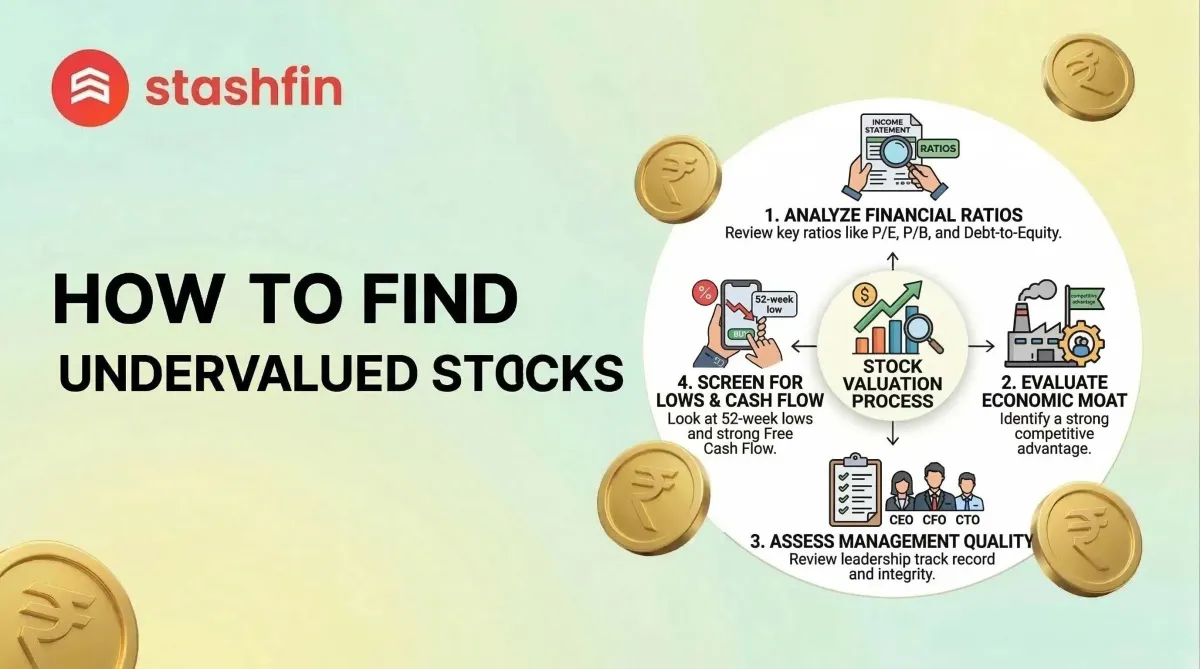
To narrow down thousands of stocks into a watchlist, you need to use filters. Think of these as the "vital signs" of a company.
- P/E Ratio (Price-to-Earnings): Compares price to profit. In 2026, look for companies trading below their 5-year historical average or sector peers.
- P/B Ratio (Price-to-Book): Tells you what you’re paying for actual assets (factories, cash, land). A P/B under 1.0 suggests the market values the company at less than its liquidation value.
- Debt-to-Equity: High debt kills value. Look for a ratio below 1.5. You want companies that own their future, not ones working for their bankers.
- Earnings Yield: The inverse of the P/E ($1 / (P/E)$). If this is higher than the current 10-year Government Bond yield, you're getting a better deal than "risk-free" money.
2. Calculating Intrinsic Value (The DCF Method)
If you want to move beyond simple ratios, use Discounted Cash Flow (DCF). This concept is simple: a business is worth the total of all the cash it will ever make, brought back to today's value.
Why? Because ₹100 today is worth more than ₹100 five years from now.
In 2026, many investors use a "Reverse DCF" to see what growth the current market price is implying. If the market price suggests a 2% growth, but your research suggests 8%, you've found a gem.
3. The Qualitative "Gut Check"
Numbers only tell half the story. To avoid a "Value Trap" (a stock that is cheap because the business is dying), ask these three questions:
- Is the Moat Still There? Does the company have a brand, patent, or cost advantage competitors can't touch?
- Is the Problem Temporary? Was the drop caused by a one-time event (e.g., a factory fire or sector slump)? Those are "buy" signals.
- Is Management Competent? Look for smart Capital Allocation. Are they buying back shares when cheap or wasting money on vanity projects?
4. Where to Look in 2026
Where is the value hiding right now?
| Sector/Category | Why it’s Undervalued |
|---|---|
| "Boring" Sectors | Industrials and Logistics often have steady cash flows but are ignored for "flashy" AI stocks. |
| Mid-Cap Diamonds | Stocks with market caps between ₹5,000 cr and ₹20,000 cr hit the "sweet spot" of stability and neglect. |
| Spin-offs | When a division is spun off, institutional selling often drives prices down regardless of actual value. |
Final Thoughts: Patience is the Hardest Part
Finding an undervalued stock is the easy part. Holding it while the market ignores it for 18 months is the hard part.
Value investing requires a thick skin. You will often look "wrong" for a long time before the market realizes you were right. As Benjamin Graham said:
"In the short run, the market is a voting machine; in the long run, it’s a weighing machine."


