


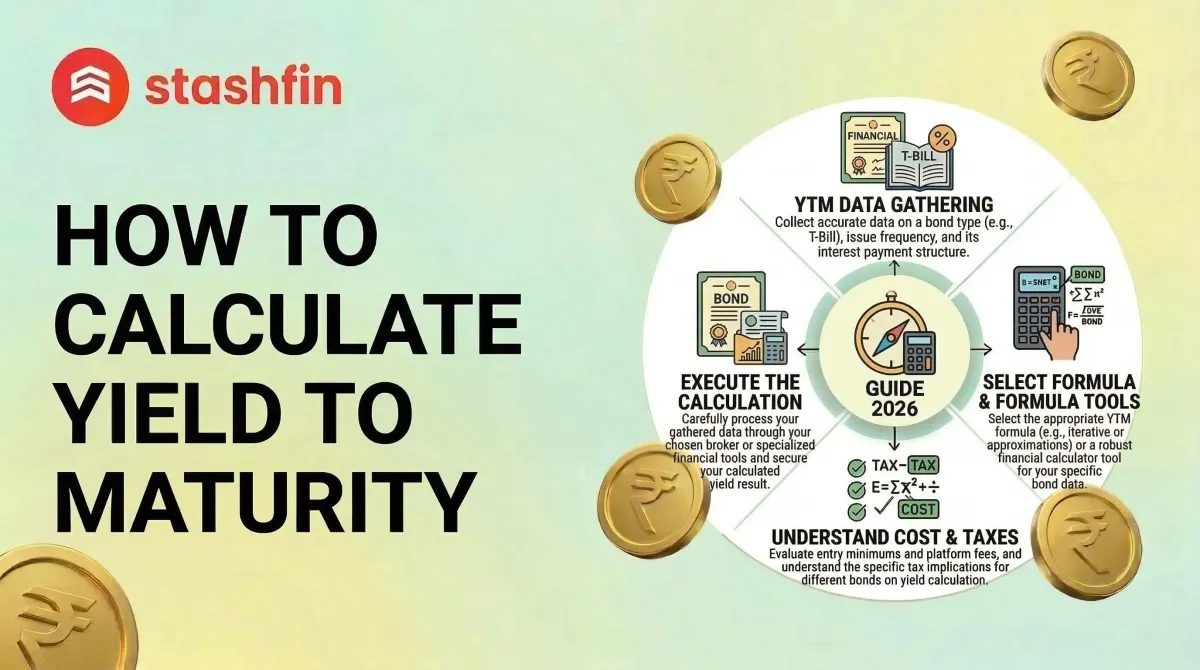
Understanding Yield to Maturity (YTM): A Complete Guide
Yield to Maturity (YTM) is a way to see how much money you will make on a bond. It is not just the interest you get every year. It also looks at how much you paid for the bond and how much you get back when the bond ends.

Think of it like a total score for your investment. If you buy a bond today and keep it until the very last day, the YTM tells you your average yearly profit.
Why You Need to Know YTM
Comparing Different Bonds
Not all bonds are the same. Some have high interest but cost a lot of money. Others have low interest but are very cheap. YTM lets you compare them fairly. It turns everything into one percentage number.
Seeing the Full Profit
If you buy a bond for less than its face value, you make extra money at the end. If you pay more, you lose some money at the end. YTM includes these gains or losses. Without YTM, you are only seeing half the story.
The Simple YTM Formula
Calculating the exact YTM is very hard. It usually requires a computer. However, investors use an Approximate Formula to get a very close answer.
$$YTM \approx \frac{C + \frac{F - P}{n}}{\frac{F + P}{2}}$$
What the Letters Mean
To use this, you need to know these four things:
- C (Coupon): The dollar amount of interest you get each year.
- F (Face Value): The value of the bond when it ends (usually $1,000).
- P (Price): What you paid to buy the bond today.
- n (Years): How many years are left until the bond ends.
Step-by-Step: How to Calculate YTM
Let's break the formula into small, easy steps.
- Step 1: Find the Annual Interest
Look at your bond. Find the coupon rate. If the bond is $1,000 and the rate is 5%, your interest (C) is $50 per year. - Step 2: Find the Yearly Gain or Loss
Subtract your price (P) from the face value (F). Then, divide that by the number of years (n).- If you bought the bond cheap, this is a gain.
- If you bought it for a high price, this is a loss.
- Step 3: Find the Average Price
Add your price (P) and the face value (F) together. Divide by 2. This gives you the average amount of money you have tied up in the bond. - Step 4: Divide to Get Your Answer
Take the result from Step 1 and Step 2 and add them. Then, divide that total by the average price from Step 3. Multiply by 100 to get a percentage.
A Real Example
Let’s say you buy a bond with these details:
- Face Value (F): $1,000
- Price (P): $920 (You bought it at a discount!)
- Interest (C): $50 per year
- Years (n): 10 years
Calculation:
- Yearly Gain: $1,000 - $920 = $80$. $80 / 10 \text{ years} = $8 \text{ per year}$.
- Top Part of Formula: $$50 \text{ (Interest)} + $8 \text{ (Gain)} = $58$.
- Average Price: $($1,000 + $920) / 2 = $960$.
- Final YTM: $$58 / $960 = 0.0604$.
As a percentage, that is 6.04%. Even though the interest rate was 5%, your YTM is 6.04% because you bought the bond for a low price!
Things to Remember
- Price and Yield move opposite: When bond prices go up, the YTM goes down. When prices go down, the YTM goes up.
- Reinvestment: This formula assumes you take your interest payments and put them back into the bond.
- Time matters: The closer the bond is to its end date, the more the price matters.
| If you buy a bond at... | Then your YTM will be... |
|---|---|
| Par ($1,000) | Same as the interest rate |
| Discount (Under $1,000) | Higher than the interest rate |
| Premium (Over $1,000) | Lower than the interest rate |
Conclusion
Calculating Yield to Maturity (YTM) is the best way to see the "big picture" of a bond investment. It moves beyond the simple interest rate to show you exactly what your money is doing over time. By looking at the price you pay, the interest you earn, and the final value of the bond, you can make smarter choices for your portfolio.
Key Takeaways:
- YTM is your total yearly return if you hold the bond until the end.
- Buying a bond at a discount makes your YTM higher.
- Buying a bond at a premium makes your YTM lower.


