





















 Back
Back
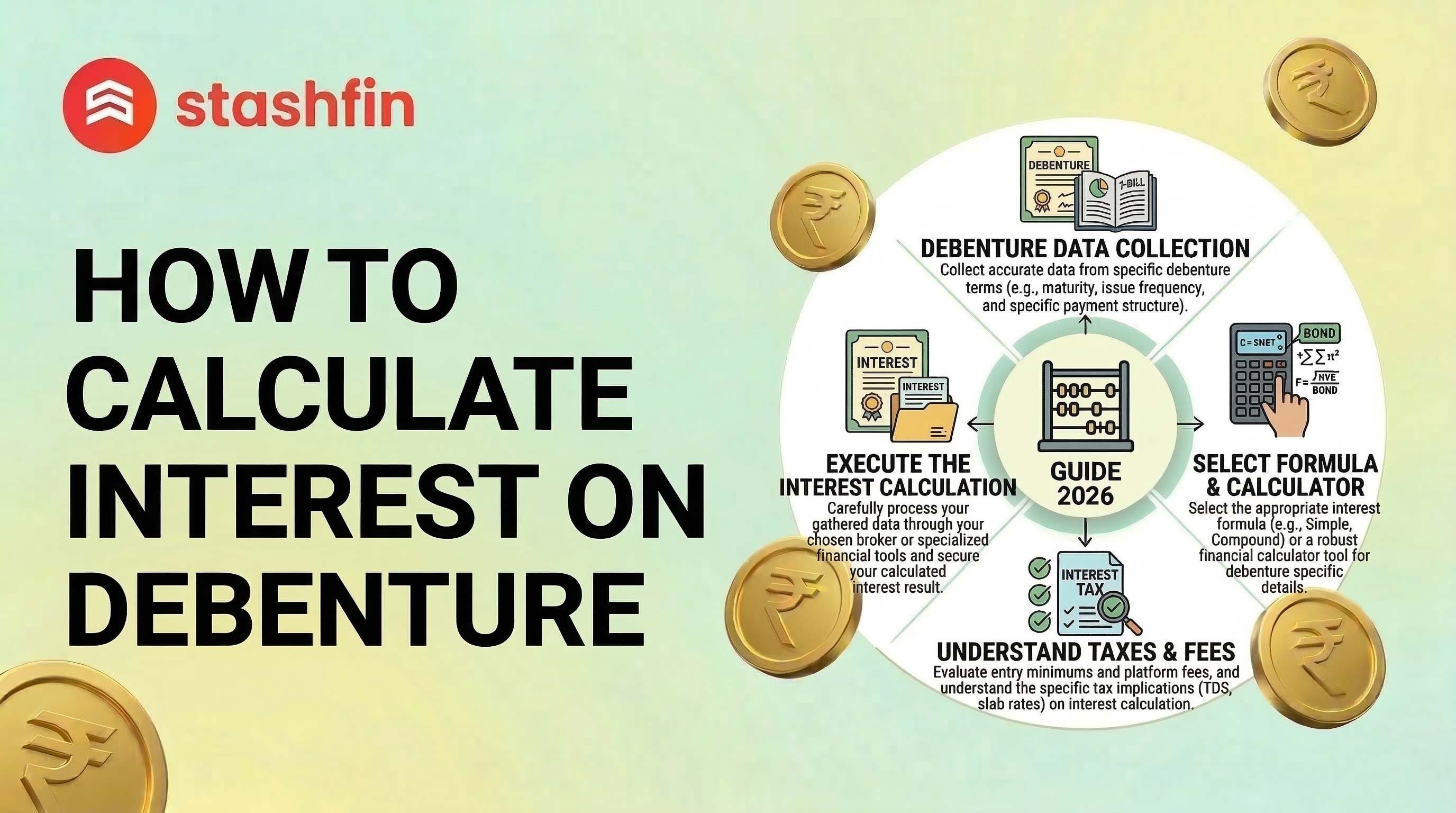

How to Calculate Interest on Debenture
Calculating the money you earn from a debenture is as easy as 1-2-3; here is the simple way to find your interest.


What is a Debenture?
A debenture is like a loan. You give money to a company, and the company promises to pay you back later. While they have your money, they pay you a fee. This fee is called interest.
What is Debenture Interest?
Interest is the reward for lending your money. It is usually a fixed amount paid every year or every six months. Crucially, the company must pay you interest even if they do not make a profit.
The Simple Formula for Calculating Interest
To find the interest, you need three specific numbers:
- Face Value: The original price/par value of the debenture.
- Interest Rate: The percentage the company pays (also called the Coupon Rate).
- Time: How long the company keeps your money (expressed in years).
The math formula looks like this:
$$Interest = \text{Face Value} \times \frac{\text{Rate}}{100} \times \text{Time}$$
1. Understanding Face Value
The Face Value is the price written on the certificate. It does not change. Even if the market price of the debenture goes up or down on a stock exchange, you always calculate interest on the Face Value.
2. Understanding the Interest Rate
The Rate is a percentage. If a debenture offers 10%, it means you receive $10 for every $100 of Face Value you hold.
3. Understanding Time
Time is usually measured in years.
- If you hold the debenture for one year, Time = 1.
- If you hold it for 6 months, Time = 0.5.
Step-by-Step Example: Let’s Do the Math
Let us look at a practical example:
- Face Value: $1,000
- Interest Rate: 8%
- Time: 1 Year
Step 1: Change the percentage to a decimal or fraction.
$8%$ becomes $8/100$ or $0.08$.
Step 2: Multiply the Face Value by the rate.
$$1,000 \times 0.08 = $80$.
Step 3: Multiply by the time.
$$80 \times 1 = $80$.
Your total annual interest is $80.
How Does TDS (Tax) Change the Calculation?
In 2026, many countries collect tax before you receive your payout. This is called Tax Deducted at Source (TDS).
If the tax rate is 10%, the company keeps 10% of your interest and sends it to the government:
- Total Interest: $80
- TDS (10%): $8
- Net Money You Keep: $72
Note: Always check if the advertised rate is "Gross" (before tax) or "Net" (after tax) to understand your actual take-home earnings.
Interest Accrued vs. Interest Due
Sometimes you earn money, but it is not time to get paid yet.
- Accrued: You have earned the money because time has passed, but the payment date hasn't arrived.
- Due: The official date has arrived for the company to send you the check.
If you sell your debenture halfway through the year, you are generally entitled to the accrued interest for the months you held the investment.
Summary Table for Quick Reference
| Term | What it Means |
|---|---|
| Face Value | The starting price of the loan (Principal). |
| Coupon Rate | The fixed percentage of interest offered. |
| Maturity | The date when the loan ends and principal is returned. |
| TDS | Tax taken out of your payout by the company. |
| Payable | The specific amount the company must pay you soon. |
Conclusion
Calculating interest on a debenture is a simple skill that helps you know exactly how much your money is earning. By using the Face Value, Rate, and Time, you can plan your 2026 savings effectively. As long as you account for TDS, you will always know if a debenture is a good deal for your portfolio.

