


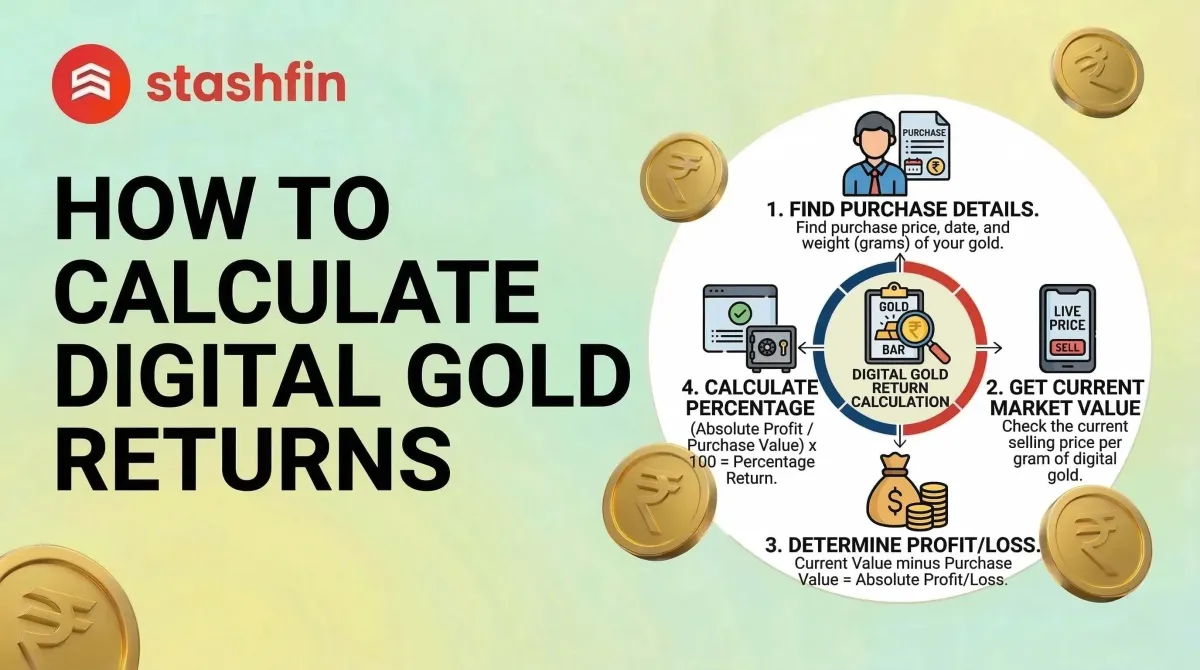
The "Real Money" Math: How to Figure Out Your Profits on Digital Gold
Bought your first gram of gold and wondering how much profit you've made? We simplify the Digital Gold return calculation process for you. Learn how to account for GST, market price shifts, and spreads to find out exactly what your investment is worth today.

1. The Golden Rule of Digital Gold Returns
Unlike a Fixed Deposit (FD) where the bank tells you "you will get 7% interest," gold doesn't pay interest. Your return comes purely from price appreciation.
The Simple Formula: $\text{Profit} = \text{Current Sell Value} - \text{Total Buying Cost}$
If the market price of gold goes up, you make money. If it goes down, your investment value drops.
2. Step 1: Calculate Your "Total Buying Cost"
When you buy digital gold on Stashfin, the price you see isn't the only thing you pay. There is a "gatekeeper" called GST.
- The GST Factor: Every time you buy digital gold in India, you pay a mandatory 3% GST.
- The Math: If you invest ₹1,000, approximately ₹970.87 goes into buying gold, while ₹29.13 goes to the government.
- Why this matters: Your gold price needs to rise by at least 3% just for you to break even on the tax you paid upfront.
3. Step 2: Understand the "Buy-Sell Spread"
Have you noticed that the "Buy" price on the app is always higher than the "Sell" price? This gap is called the Spread. Platforms use this 2% to 3% margin to cover:
- Secure storage in insured vaults (like Brink's).
- Comprehensive insurance against theft or damage.
- Operational and technology costs.
Example Calculation:
If the market rate is ₹7,500/gram:
- Buying Price: You might pay ~₹7,950 (Market + GST + Platform Spread).
- Selling Price: The platform might buy it back at ~₹7,350 (Market - Platform Spread).
4. Step 3: Annualized Returns (CAGR)
If you hold your gold for more than a year, you should calculate the CAGR (Compound Annual Growth Rate) to compare it with other investments like Mutual Funds.
$$CAGR = \left[ \left( \frac{\text{Ending Value}}{\text{Beginning Value}} \right)^{\frac{1}{n}} - 1 \right] \times 100$$
(Where $n$ is the number of years you held the investment)
5. Don't Forget the Taxes (2026 Rules)
Before you celebrate your profit, remember the 2026 tax provisions for digital gold:
- Short-Term (Held < 24 months): Your profit is added to your total income and taxed as per your applicable income tax slab.
- Long-Term (Held > 24 months): Your profit is taxed at a flat 12.5% (without indexation benefits).
6. Tips to Maximize Your Returns
- Buy the Dips: Gold prices fluctuate based on global news. When you see a 2-3% drop, it’s a strategic time to add to your Stashfin vault.
- Think Long Term: Because of the upfront GST and exit spreads (~6% total impact), digital gold is not for "day trading." Aim to hold for at least 1–3 years.
- Use the "Gold SIP" Strategy: Invest small amounts weekly. This Rupee Cost Averaging ensures you don't have to worry about the "perfect" market entry time.
Conclusion
Calculating digital gold returns is easy once you realize your profit is always based on the Live Sell Price shown in your app. Ready to see your money grow? Open the Stashfin app, check your gold balance, and do the math today!


