


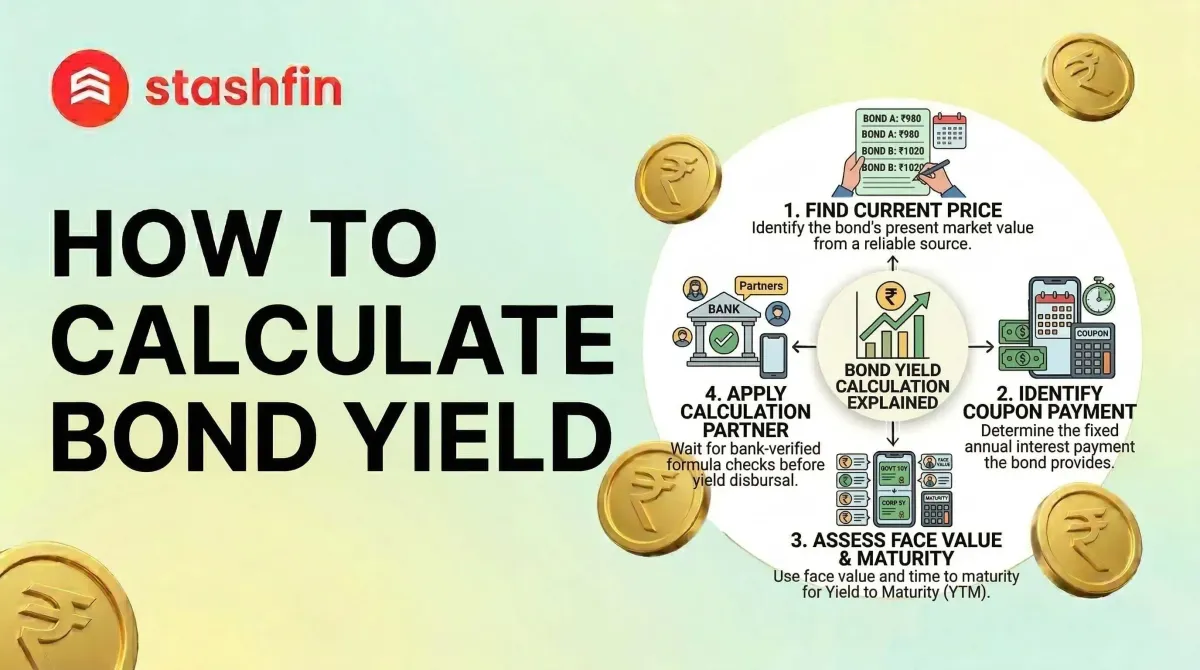
What is Bond Yield?
When you buy a bond, you are acting like a bank. You lend your money to a government or a company. In exchange, they promise to pay you back later. While they have your money, they pay you "rent." This rent is called interest.

Bond yield is a tool—a percentage that tells you exactly how much money you are making on your investment every year.
Debt, Interest, and Your Profit
Think of a bond like a loan to a friend. If you lend a friend $100 and they give you $5 every year as a "thank you," your yield is 5%. It is that simple. However, in the real world, bonds are bought and sold on a market. The price changes every day. Because the price changes, the yield changes too.
Why Yield Matters More Than Price
Imagine two bonds. Bond A costs $1,000. Bond B costs $900. Which one is better? You can't tell just by looking at the price. You need to know the yield. The yield lets you compare a cheap bond to an expensive bond to see which one puts more cash in your pocket.
The Core Components of a Bond
To calculate yield, you must know these three building blocks:
- Face Value (Par Value): The amount the bond is worth when first made (usually $1,000). This is what you get back on the last day.
- Coupon Rate: The fixed interest rate. A 5% coupon on a $1,000 bond pays $50 a year—this check never changes.
- Market Price: What you actually pay for the bond today. If investors want it, the price goes up; if they don't, it goes down.
Calculating Current Yield (Step-by-Step)
The Current Yield tells you your return right now based on the price you paid today.
The Simple Math Formula
$$Current Yield = \left( \frac{\text{Annual Interest}}{\text{Current Market Price}} \right) \times 100$$
Case Study: The Discount Bond
You buy a bond for less than its face value.
- Face Value: $1,000
- Coupon: 6% ($60/year)
- Market Price: $800
- Calculation: $($60 / $800) \times 100 = \mathbf{7.5%}$
- Result: Your yield is higher than the coupon rate because you got a bargain.
Case Study: The Premium Bond
You buy a popular bond for more than its face value.
- Face Value: $1,000
- Coupon: 6% ($60/year)
- Market Price: $1,200
- Calculation: $($60 / $1,200) \times 100 = \mathbf{5%}$
- Result: Your yield is lower than the coupon rate because you paid extra.
Yield to Maturity (YTM): The Full Story
Current yield ignores the future. If you buy a bond for $800 and it pays back $1,000 in ten years, you made an extra $200. Yield to Maturity (YTM) counts that profit.
Factoring in Time and Gains
YTM is the "gold standard" because it calculates your total return assuming:
- You keep the bond until the very last day (maturity).
- You reinvest every interest payment at the same rate.
The Simplified YTM Approximation Formula:
$$YTM \approx \frac{C + \frac{F - P}{n}}{\frac{F + P}{2}}$$
Where $C$ = Annual Coupon, $F$ = Face Value, $P$ = Price, and $n$ = Years to Maturity.
The Relationship Between Price and Yield
This is the most important rule in bond investing: The Seesaw Effect.
- When Price goes UP, Yield goes DOWN.
- When Price goes DOWN, Yield goes UP.
Why do prices move?
In 2026, if the government raises interest rates, new bonds will pay 7%. If your old bond only pays 5%, it's less attractive. To sell it, you must lower the price. As your price drops, the yield for the new buyer rises until it matches the market.
Other Types of Yield to Know
- Yield to Call (YTC): Used for "callable" bonds that the company can pay back early. It tells you your profit if the deal ends sooner than expected.
- Tax-Equivalent Yield: Helps you compare tax-free government bonds to taxable corporate bonds. A 4% tax-free bond might be better than a 6% taxable one depending on your bracket.
Summary: Building a Portfolio
In 2026, smart investors use a Yield Ladder, buying bonds with different maturities (1, 5, and 10 years). This ensures a steady flow of cash while allowing you to reinvest in higher yields if interest rates rise.
Final Tip: * High Yield = High Risk (Junk Bonds).
- Low Yield = High Safety (Government Bonds).


