





















 Back
Back
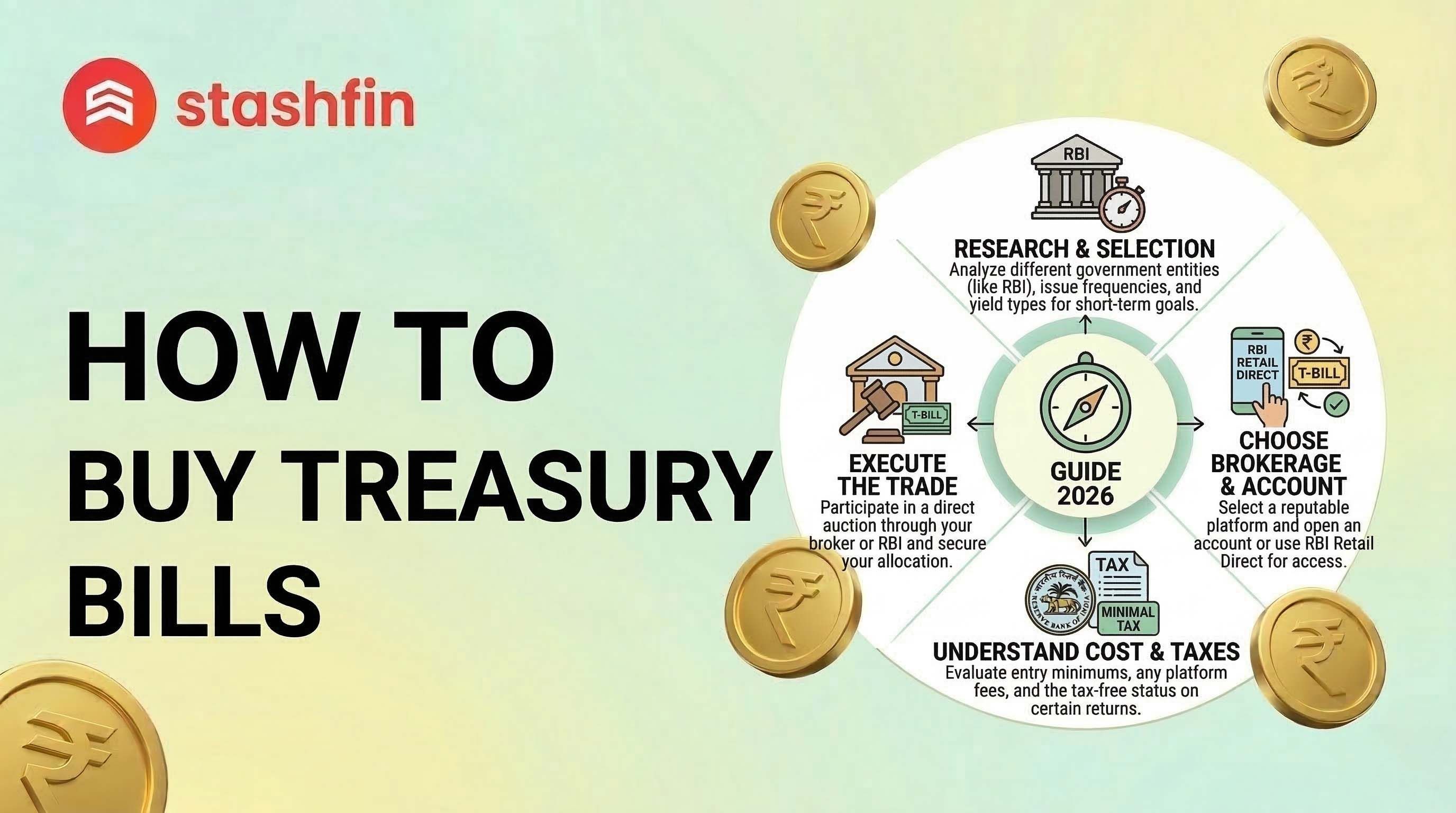

What are Treasury Bills (T-Bills) in India?
Treasury Bills, or T-Bills, are short-term loans you give to the Government of India. When the government needs money for a few months to fund infrastructure or manage cash flow, they ask the public for help. In return, they give you a guarantee that your money is 100% safe.


In India, T-Bills are managed by the Reserve Bank of India (RBI). They are considered the safest investment in the country because they carry a "Sovereign Guarantee"—meaning the government will always pay its debts.
The Three Types: 91-Day, 182-Day, and 364-Day
You cannot buy a T-Bill for any random number of days. The RBI offers three specific "tenures" or time frames:
- 91-Day T-Bills: Good for very short-term goals.
- 182-Day T-Bills: Best for money you need in roughly 6 months.
- 364-Day T-Bills: Best for money you want to park for a full year.
How You Earn: The "Discount" Secret
T-Bills are unique because they do not pay "interest" like a bank does. They are Zero-Coupon bonds. This means you buy them at a price lower than their value.
- Face Value: Every T-Bill has a face value of ₹100.
- Purchase Price: You might buy it at a discount for ₹98.20.
- Your Profit: At the end of the term (say 91 days), the RBI gives you ₹100. Your profit is the ₹1.80 difference.
T-Bills vs. Bank FDs: Which is Better in 2026?
| Feature | Treasury Bills (T-Bills) | Bank Fixed Deposits (FD) |
|---|---|---|
| Safety | Highest (Govt Backed) | High (Up to ₹5 Lakh insured) |
| Minimum Investment | ₹10,000 | Varies (often ₹1,000 to ₹5,000) |
| TDS (Tax at Source) | No TDS deducted | 10% TDS if interest > ₹40,000 |
| Liquidity | Highly Liquid (Secondary Market) | Penalty for early withdrawal |
| Returns | Market-linked (~6.8% - 7.2% in 2026) | Fixed by the bank |
Pre-requisites: What You Need to Get Started
To buy T-Bills in India today, you need four simple things:
- PAN Card: Mandatory for all financial investments.
- Savings Bank Account: To send and receive funds.
- Mobile Number: Must be linked to your Aadhaar for OTP verification.
- Internet Banking or UPI: For seamless digital payment.
Step-by-Step: Buying T-Bills via RBI Retail Direct
The best way to buy is the RBI Retail Direct portal. It is free and has no hidden fees.
Step 1: Opening your RDG Account
Go to rbiretaildirect.org.in. Click on "Register." You will need to upload your signature and a cancelled cheque. The KYC process is done via a Video call. It usually takes 24–48 hours for account activation.
Step 2: Bidding (The Primary Market)
The RBI auctions T-Bills every Wednesday.
- Log in and go to the "Primary Market" tab.
- Select the T-Bill you want (91, 182, or 364 days).
- Non-Competitive Bidding (NCB): As a retail investor, you don't guess the price. You simply get the average market price.
- Payment: Pay via UPI or Net Banking.
Note: RBI takes a small extra "markup" (2-3%) initially to cover price fluctuations. This extra amount is refunded to your bank account within a few days after the auction.
Method 2: Buying via Stock Brokers
If you use apps like Zerodha (Coin), Upstox, or Groww:
- Go to the "Government Securities" or "Bonds" section.
- Select the T-Bill and apply. These will be stored in your Demat account.
Tax Rules for T-Bills (2026-27)
- Short-Term Capital Gains: The profit (the discount amount) is added to your total income.
- Tax Slab: You pay tax according to your personal income tax slab (e.g., 5%, 20%, or 30%).
- No TDS Advantage: Unlike FDs, the RBI does not deduct any tax at source. You get the full amount and handle the tax during your ITR filing.
Summary: Why Choose T-Bills?
T-Bills are the ultimate "safety net" for your short-term savings. They offer higher security than banks, no TDS, and the flexibility to sell early on the NDS-OM (secondary market) if you need cash urgently.
Would you like me to help you compare the current 2026 yields for 91-day versus 364-day T-Bills?

