


The Ultimate Guide to UPI for Business Owners
Why Your Business Needs UPI in 2026
The world has changed. In 2026, almost everyone carries a phone but rarely any cash. For any modern business—from a local tea stall to a large retail showroom—UPI is no longer optional; it is the engine of growth.

The Strategic Advantages for Merchants
1. No Transaction Fees (Zero MDR)
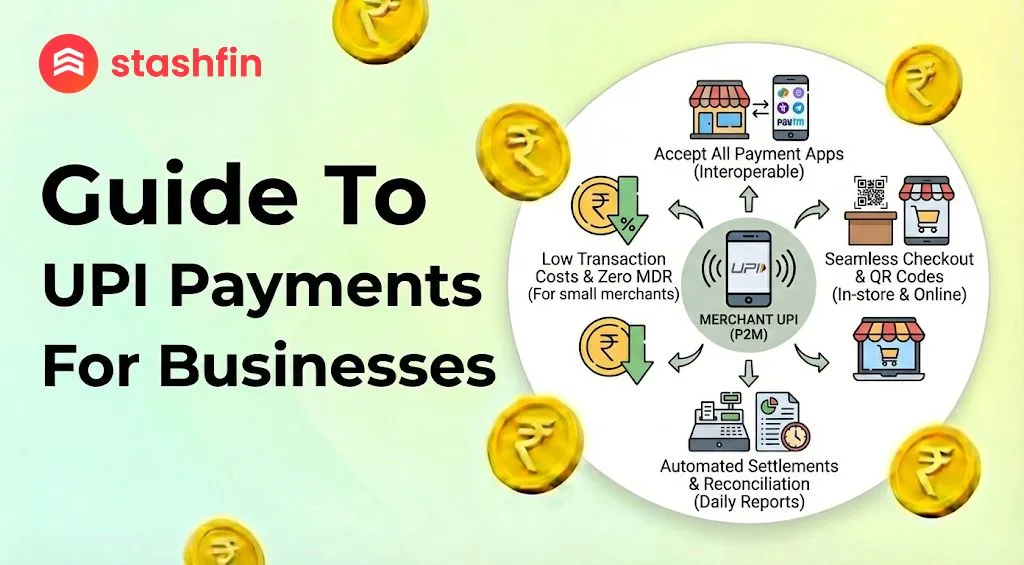
For most small shops, bank-to-bank UPI is free. Unlike credit cards that take a 2%–3% cut of your profit, the government has maintained the Zero MDR (Merchant Discount Rate) policy for standard UPI to keep businesses healthy.
2. Instant Settlement into Your Bank
When someone pays you, the money moves fast. In 2026, backend improvements mean many transactions are completed in under 15 seconds. Most UPI merchant apps settle the total amount into your bank account by the next morning, with many offering real-time instant settlement for a small convenience fee.
3. Access to 350+ Million Users
Millions of people use apps like PhonePe, Google Pay, and BHIM. By displaying a QR code, you eliminate the "no change" problem and make it easy for every smartphone user to buy from you.
Additional Read: Complete Guide to New UPI MDR Charges from 15 Oct
How to Set Up UPI for Your Business
Setting up as a merchant is a simple process that validates your business as a trusted entity.
1. Documents You Will Need
- PAN Card: Essential for tax tracking.
- Aadhaar Card: For identity verification.
- Current Account: While you can use a savings account, a Current Account is best for handling higher business volumes.
- Business Proof: Shop & Establishment license, GST certificate, or a simple "Merchant Declaration."
2. Choosing the Right Merchant App
Download a "Business" version of a major app (e.g., PhonePe Business, Google Pay for Business).
- Sign Up: Use your mobile number linked to your business account.
- Shop Details: Enter your shop name and physical address.
- Bank Verification: Add your account number and IFSC. The app will verify it by sending a small amount (like ₹1).
- Complete KYC: Upload photos of your documents. Approval usually takes 24 to 48 hours.
Modern Ways to Accept UPI Payments in 2026
Dynamic QR Codes
Unlike the "sticker on the wall" (Static QR), a Dynamic QR is generated for each sale. You type the amount in your app, it shows a specific QR, and the customer scans it.
- Benefit: The customer doesn't have to type the price, which prevents payment mistakes and saves time.
UPI AutoPay for Subscriptions
If you run a gym, a milk delivery service, or a subscription-based business, use AutoPay. Customers authorize a one-time mandate, and the money is deducted automatically every month.
Payment Links
Selling on WhatsApp or Instagram? Send a Payment Link. Your customer clicks it and pays instantly from their home without needing to see a physical QR code.
New UPI Rules and Limits for 2026
To keep the ecosystem secure, the following limits are in effect:
| Transaction Type | Limit (Feb 2026) |
|---|---|
| Standard Daily Limit | ₹1 Lakh (P2P and general P2M) |
| High-Value Categories | ₹5 Lakh (Hospitals, Schools, IPOs, Taxes) |
| New UPI ID Rule | ₹5,000 for the first 24 hours (Anti-fraud measure) |
| Interchange Fee | 0.5%–1.1% (Only for Prepaid Wallets > ₹2,000; bank-to-bank is still free) |
Safety Tips for Business Owners
- Wait for the Voice: Use a Soundbox. It prevents "fake screenshot" fraud by announcing "Payment of ₹100 received" out loud.
- Verify the Name: Ensure your business name appears correctly on the customer's phone during checkout.
- The PIN Rule: Remember, you NEVER need to enter your PIN to receive money. If someone asks for your PIN to "send" you a payment, it is a scam.
Summary for Success
- Get a Dedicated Business Account: It makes tax time and bank reconciliation much easier.
- Display Multiple QRs: Use different apps to ensure that if one bank server is down, you can still get paid.
- Monitor Your Limits: If you sell high-value items (like jewelry or electronics), be aware of the daily caps.
With zero fees and instant settlements, UPI helps your cash flow stay healthy so you can focus on growing your business.


