





















 Back
Back
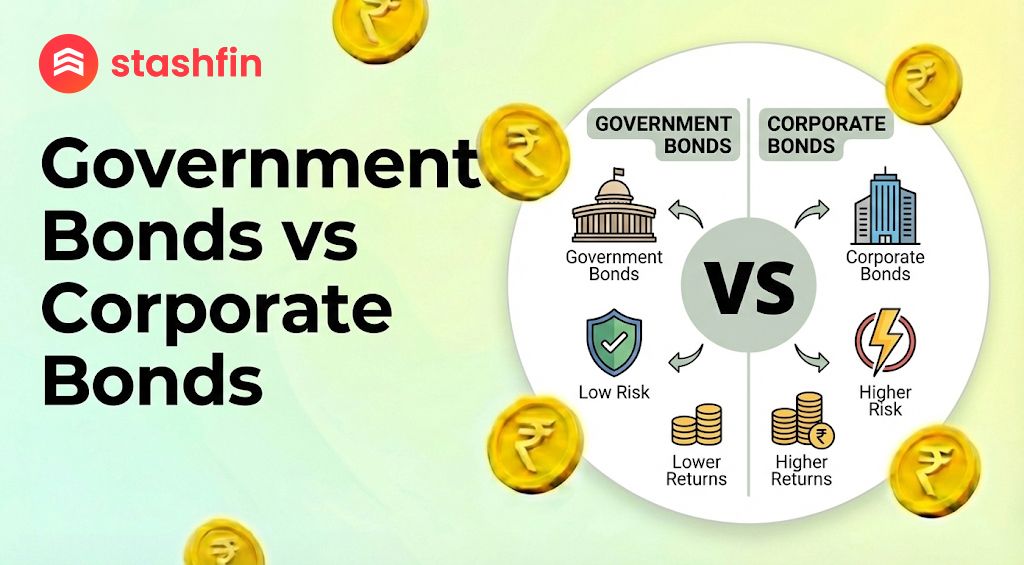

What Are Bonds? Government vs. Corporate Explained
A bond is like a loan. When you buy a bond, you are acting as the bank. You lend your money to an organization, and in return, they promise to pay you back your original money plus extra money called interest.


Lending to the Government (G-Secs)
Government bonds are often called G-Secs. When you buy these, you are lending money to the country. The government uses this cash to build roads, schools, and bridges. Because the government can collect taxes to pay you back, these are seen as the safest possible investment.
Lending to Companies (Corporate Bonds)
Corporate bonds are when you lend money to a business, such as a tech giant, a car maker, or a power company. They use your money to grow their operations. Since a business can fail more easily than a whole country, they generally pay you a higher interest rate to make it worth your while.
Key Differences at a Glance
| Feature | Government Bonds | Corporate Bonds |
|---|---|---|
| Who Issues It? | The Government | Private Companies |
| Risk Level | Very Low | Medium to High |
| 2026 Interest Rate | ~7% | 8% to 14% |
| Safety | Guaranteed by the State | Depends on Company Health |
Safety First: Which One Is More Secure?
The "Sovereign Guarantee" of Government Bonds
Government bonds are the "gold standard" of safety. It is very rare for a country to stop paying its debts. If you want to sleep well at night knowing your money is highly secure, these are for you.
Credit Ratings: How to Check Company Safety
Companies are graded by experts to help you understand their strength. These Credit Ratings act like school grades:
- AAA or AA: Very strong companies; highly likely to pay you back.
- BBB: Average companies with a bit more risk.
- C or D: Known as "junk bonds." They pay huge interest but carry a high risk of going bust.
Returns and Yields in 2026
Why Corporate Bonds Pay More
Corporate bonds pay a Risk Premium. This is the extra reward you get for taking the small chance that the company could close down.
Current 2026 Trends
In 2026, the market has settled into these predictable ranges:
- Government Bonds: Expect around 7% interest. It is steady and reliable.
- Corporate Bonds: Strong companies pay 9% to 11%, while riskier firms offer as much as 14%.
Taxes and Liquidity: What You Keep
Tax Rules
In 2026, bond interest is typically added to your total income and taxed. If you sell a bond for a profit before its end date, you may owe Capital Gains Tax.
Note: Some specific government bonds offer tax-free interest; always check the specific bond details.
Liquidity: Getting Your Cash Back
- Government Bonds: Very easy to sell. There is always a high demand.
- Corporate Bonds: Can be harder to sell, especially if the company is performing poorly.
How to Choose the Right Mix
For Cautious Savers (The Safety First Plan)
If you are retired or saving for a near-term goal, consider a mix of 80% Government Bonds and 20% high-quality (AAA) Corporate Bonds.
For Growth Seekers (The Income Boost Plan)
If you can handle a little more market movement, try a 50/50 split. Use government bonds as your safety net and corporate bonds to capture higher interest rates.
Summary: The Simple Verdict
- Choose Government Bonds if you hate risk and want a guaranteed return.
- Choose Corporate Bonds if you want more profit and are willing to monitor a company's health.
In 2026, the best move for most investors is a diversified mix of both.

