


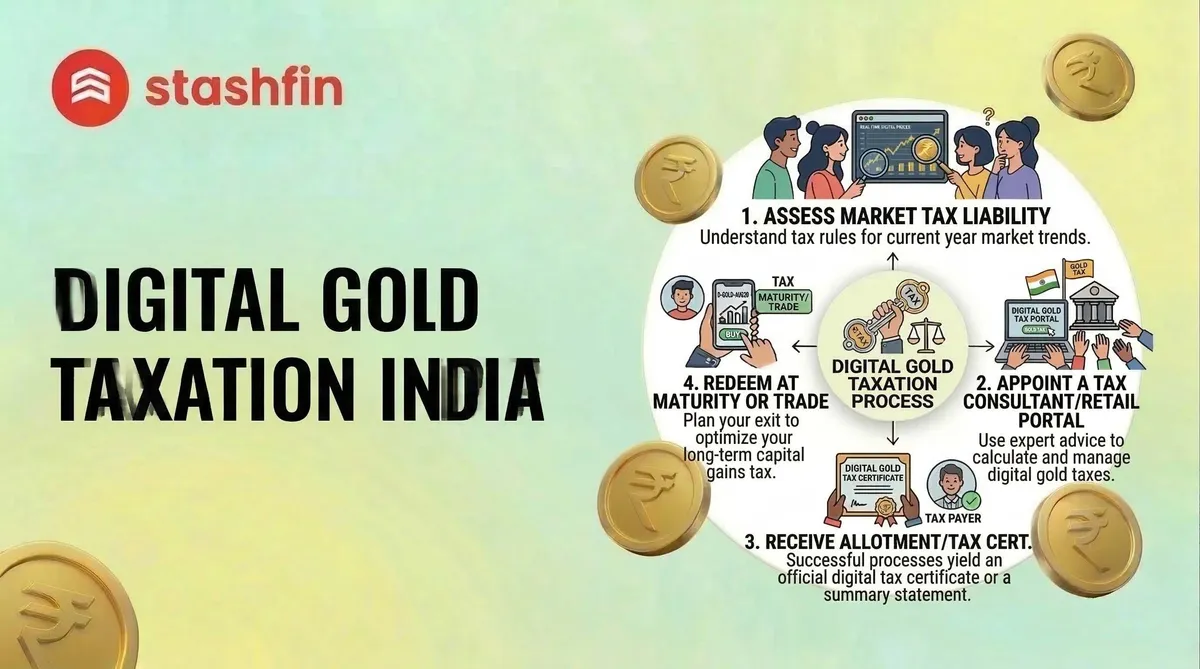
Digital Gold Taxation in India: Guide to Your 2026 Taxes
Understanding digital gold taxation in India is key to keeping your hard-earned profits. From the 12.5% LTCG flat rate (no indexation) to the 3% GST at purchase, we break down the latest 2026 rules to help you stay tax-compliant and profit-ready.

1. The First Tax: GST (The Entry Cost)
The moment you click "Buy" on the Stashfin app, your first tax encounter happens. Digital gold, like physical gold, is treated as a "good."
- The Rate: A mandatory 3% Goods and Services Tax (GST) is applied to every purchase.
- How it works: If you invest ₹10,000, only ₹9,708.74 actually goes into buying gold. The remaining ₹291.26 is paid as GST.
- Important Note: Unlike business expenses, you cannot "claim back" this GST. It is a one-time cost that becomes part of your purchase price.
2. Capital Gains Tax: The Exit Cost
The real "tax talk" starts when you decide to sell your digital gold for a profit. In India, the profit you make is classified as Capital Gains. The amount you pay depends entirely on your Holding Period—how long you kept the gold before selling.
Short-Term Capital Gains (STCG)
If you sell your digital gold within 24 months of purchase, the profit is called a Short-Term Capital Gain.
- The Rule: The profit is added to your total annual income.
- The Rate: You are taxed according to your income tax slab. If you are in the 30% bracket, your gold profit is taxed at 30%. If your total income is below the taxable limit, you might pay zero tax.
Long-Term Capital Gains (LTCG)
If you hold your digital gold for more than 24 months, it becomes a Long-Term Capital Asset.
- The Rule: A flat tax rate applies to the profit.
- The 2026 Rate: As per the major reforms of 2024–2026, LTCG on gold is taxed at a flat 12.5%.
- The "No Indexation" Shift: Previously, investors could use "indexation" to adjust their purchase price for inflation. In 2026, indexation has been removed for gold. You pay 12.5% on the absolute profit (Selling Price - Buying Price).
3. 2026 Gold Taxation Comparison Table
To help you see how Digital Gold compares to other popular gold investments in 2026, look at this breakdown:
| Feature | Digital Gold / Physical Gold | Gold ETFs | Sovereign Gold Bonds (SGB) |
|---|---|---|---|
| GST at Purchase | 3% | Nil | Nil |
| LTCG Holding Period | 24 Months | 12 Months | 8 Years (Maturity) |
| LTCG Tax Rate | 12.5% (No Indexation) | 12.5% (No Indexation) | Exempt (Primary Holders Only) |
| STCG Tax Rate | Income Slab Rate | Income Slab Rate | Income Slab Rate |
| Interest Income | None | None | 2.5% (Taxed at Slab) |
4. The "Secondary Market" Trap: New for 2026
If you’ve been considering Sovereign Gold Bonds (SGBs) as a "tax-free" alternative to digital gold, be careful. As of the 2026 Budget, the tax-free status on SGB maturity is now strictly reserved for Primary Subscribers (those who bought directly from the RBI during the initial issuance).
If you buy an SGB from the secondary market (like a stock exchange) on or after April 1, 2026, you will now pay capital gains tax upon maturity or sale, similar to digital gold.
5. Tax on Gifting and Inheritance
- Gifting: Receiving gold from "specified relatives" (parents, spouse, siblings, children) is tax-free. However, if a non-relative gifts you gold worth more than ₹50,000 in a year, it is taxed as "Income from Other Sources."
- Inheritance: Inheriting digital gold is not a taxable event. You only pay tax when you eventually sell it.
- Holding Period Calculation: For inherited gold, the holding period and the "buying price" are calculated from the date and price at which the original owner bought it.
6. How to Report Digital Gold in Your ITR
- STCG: Report this under the head "Income from Other Sources" or as short-term capital gains in the specialized capital gains schedule.
- LTCG: Report this under Schedule CG (Capital Gains). You will need the purchase date, sale date, and total transaction value.
- Audit Trail: Platforms like Stashfin provide detailed transaction histories. Always download your annual statement to prove the 3% GST paid and investment dates.
7. Strategies to Minimise Your Gold Tax
- The 24-Month Rule: Avoid selling before the 2-year mark if you are in a high tax bracket (20% or 30%). Waiting until month 25 allows you to benefit from the lower 12.5% flat rate.
- Tax-Loss Harvesting: If you have made losses in other assets (like stocks), you can "set off" those losses against your gold profits to reduce your total taxable income.
- Section 54F: You can save 100% of your LTCG tax by reinvesting the sale proceeds into a residential house property within the prescribed time limits.
Conclusion: Knowledge is Profit
In 2026, Digital Gold Taxation in India is simpler but stricter. The removal of indexation means you need to focus on assets that offer high growth to beat both inflation and taxes. By planning your holding period and keeping clear records, you can ensure that your "digital nest egg" stays as profitable as possible.


