


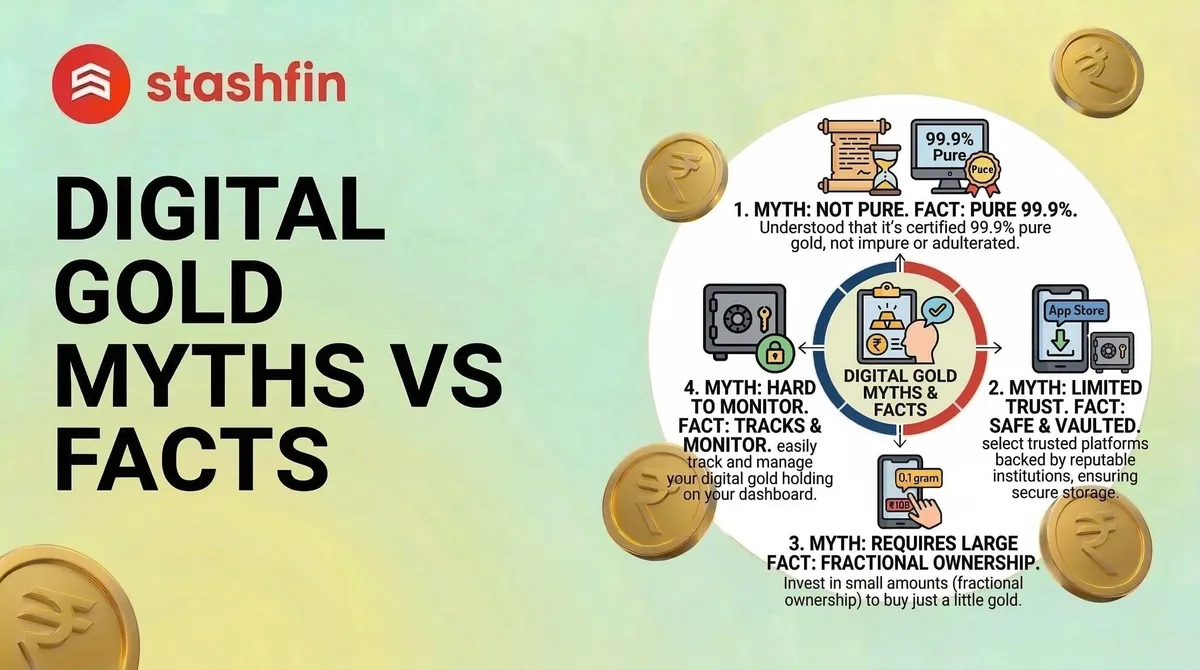
Beyond the Hype: Busting the 7 Biggest Digital Gold Myths in 2026
Digital gold has become a cornerstone of the modern Indian portfolio. As we navigate 2026, the metal remains a "safe haven" amid global volatility, but misinformation still lingers. If you're a Stashfin user or a first-time investor, it's time to separate the noise from the numbers.

Myth 1: Digital Gold is just a "Paper Token" or a Number
Fact: This is the most common misconception. When you buy digital gold on a platform like Stashfin, you aren't just buying a line of code. For every milligram you purchase, the provider buys physical 24K, 99.9% pure gold and stores it in an institutional-grade, insured vault. You hold the legal title to that physical metal; the app is simply your digital key to the vault.
Myth 2: It’s only for the wealthy who have thousands to spare
Fact: In 2026, gold has been democratised. While physical gold coins or jewelry require a significant upfront payment, digital gold allows you to start with as little as ₹10. This "micro-investing" capability is why 62% of Gen Z and Millennials now prefer digital gold over traditional stocks for their first investment (as reported in the Smytten PulseAI 2026 Gold Investment Report).
Myth 3: Digital Gold isn’t as "Pure" as jewelry from a store
Fact: Actually, digital gold is often purer. Jewelry is usually 22K or 18K (to make it durable for wearing), and its purity can vary by shop. Digital gold is almost exclusively 24K (99.9% or 999.9 fineness).
Myth 4: The SEBI Warning means Digital Gold is illegal or a scam
Fact: Not at all. SEBI’s 2025-2026 advisories were meant to inform, not ban. Digital gold is a commercial product, not a "security" like a stock. SEBI is simply clarifying that if a platform fails, you won't have the same "investor protection" path (like the SCORES portal) as you do with ETFs. It’s a call to choose reputable platforms like Stashfin with independent trustees rather than a sign of illegality.
Myth 5: You lose more money in GST and Spreads than physical gold
Fact: Both physical and digital gold attract a 3% GST at purchase. While digital gold has a 2-3% "spread" (buy-sell gap), physical jewelry carries 8% to 25% in making charges. Even with the spread, digital gold is significantly more cost-efficient for pure wealth building.
Myth 6: If the app shuts down, my gold is gone forever
Fact: Your gold is held by a custodian, not the app. These custodians appoint an Independent Trustee to audit the vaults. Even if your favorite app disappears tomorrow, your ownership record is safe with the custodian, and you can claim your gold using your details.
Myth 7: Digital Gold is complex and hard to sell
Fact: It is arguably the most liquid asset in your portfolio. You don't need to find a jeweler or get a purity test. You can sell your gold 24/7 at live market rates and receive the cash in your bank account via UPI within minutes.
The 2026 Reality Check: Purity and Taxation
To be a smart investor in 2026, you need to know the latest rules:
| Feature | 2026 Reality |
|---|---|
| Standard Purity | 24K (99.9%) |
| GST Rate | 3% (Standard) |
| Short-Term Tax (<24 months) | Added to your income (Slab Rate) |
| Long-Term Tax (>24 months) | 12.5% (Without indexation) |
Why Stashfin Digital Gold?
Choosing the right platform is the key to safety. At Stashfin, we prioritise transparency:
- Real-time Tracking: See your gold grams and their current market value 24/7.
- Institutional Security: Your gold is stored in world-class, insured vaults.
- Fractional Ownership: Buy exactly what you can afford, down to the last rupee.
Conclusion
Digital gold is no longer a myth; it is a mathematical reality for the modern Indian investor. By separating the noise from the facts, you can see that it offers a unique combination of purity, safety, and accessibility. While it lacks the regulatory "safety net" of an ETF, choosing a trusted partner makes it a powerful tool for short-term goals and micro-savings.


