


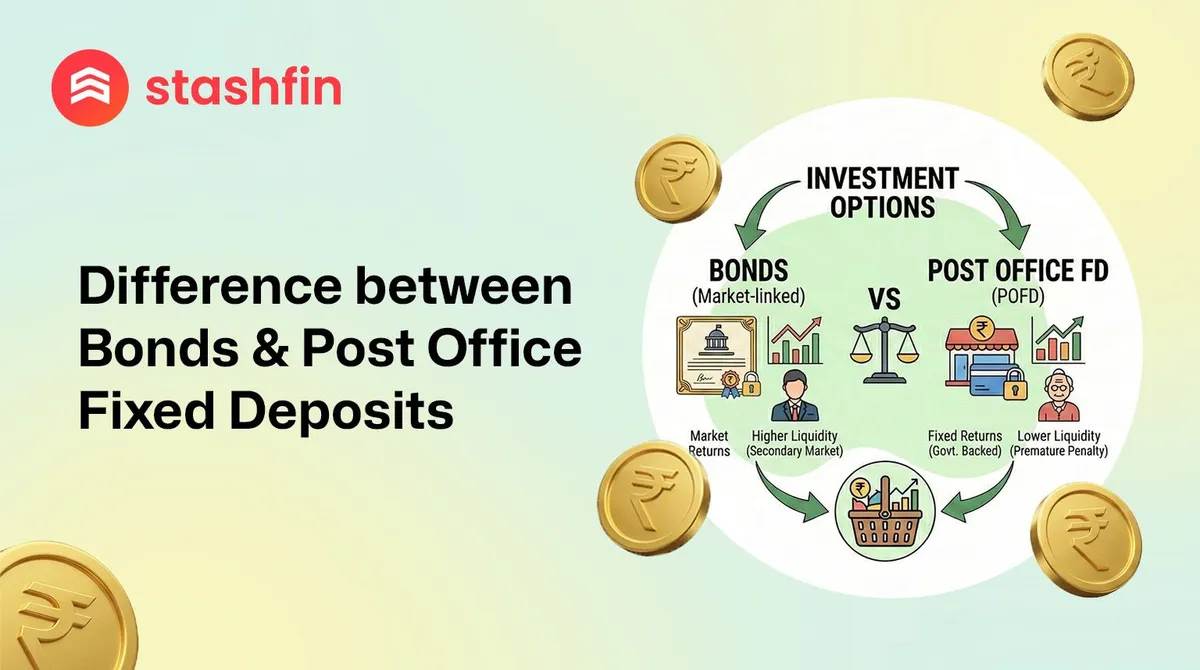
Bonds vs. Post Office Fixed Deposits: 2026 Comparison Guide
Balance absolute safety with high-alpha returns in your fixed-income portfolio
Getting an instant personal loan with Stashfin is quick and 100% digital.

- Sovereign Guarantee: Post Office FDs offer the highest form of capital protection in India.
- Tax Savings: 5-Year Post Office FDs provide Section 80C benefits; certain bonds offer tax-free interest.
- Liquidity: Trade bonds in the secondary market or hold FDs for guaranteed maturity payouts.
What is the Difference Between Bonds and Post Office FD?
The core difference between bonds and post office FD lies in who you are lending to and how the returns are structured.
- Post Office FD: Formally known as a National Savings Time Deposit, this is a direct loan to the Government of India. It is 100% secure and offers a fixed return for a set tenure (1, 2, 3, or 5 years).
- Bonds: These are debt instruments issued by corporations (NBFCs, Private Firms) or the Government. A Corporate Bond is a loan to a company to fund its growth, in exchange for regular interest payments.
Bonds vs. Post Office FD Rates (2026)
As of January 2026, there is a significant gap between the guaranteed returns of the Post Office and the "Alpha" returns of corporate bonds.
| Tenure | Post Office FD Rate (2026) | Akara Capital Bonds (Stashfin) |
|---|---|---|
| 1 Year | 6.90% p.a. | 14.5% p.a. |
| 2 Years | 7.00% p.a. | 14.5% p.a. |
| 3 Years | 7.10% p.a. | 14.5% p.a. |
| 5 Years | 7.50% p.a. | 14.5% p.a. |
| Payout Frequency | Annual | Fixed Monthly Returns |
Strategic Note: For every ₹10 Lakh invested, an Akara Capital Bond generates approximately ₹1,20,833 in interest over 10 months, compared to roughly ₹57,500 in a 1-year Post Office FD.
Safety, Risk, and Liquidity
When choosing between bonds vs post office FD, your decision depends on your risk tolerance and need for cash.
1. Safety & Credit Risk
- Post Office FD: Carries a Sovereign Guarantee. It is the safest investment in the country; default is virtually impossible.
- Bonds: Safety depends on the Credit Rating (AAA, AA, BBB). Corporate bonds like Akara (BBB-rated) are "Investment Grade," meaning they are monitored by agencies like CRISIL/ICRA but carry more risk than a government deposit.
2. Liquidity (Getting Your Money Back)
- Post Office FD: Your money is locked for the tenure. Premature withdrawal is allowed after 6 months, but you face a penalty (usually 1-2% lower interest).
- Bonds: Many bonds are listed on exchanges. You can sell them in the secondary market if you need cash instantly, though the price may vary based on market interest rates.
3. Payout Frequency
- Post Office FD: Interest is compounded quarterly but paid annually.
- Bonds: You can find bonds with monthly, quarterly, or annual payouts. Akara Capital Bonds provide fixed monthly interest, making them ideal for those seeking regular income.
Taxation Overview
Both instruments are subject to income tax, but the rules for deductions differ:
- Section 80C: Only the 5-Year Post Office FD qualifies for a tax deduction of up to ₹1.5 Lakh under the old tax regime. Most corporate bonds do not offer this specific benefit.
- TDS: Post Office FDs usually do not deduct TDS (though interest is still taxable). For listed corporate bonds, TDS is generally not applicable, but for unlisted ones, 10% TDS may apply.
- Capital Gains: If you sell a bond in the secondary market at a profit, you pay capital gains tax. Post Office FDs do not have capital gains as they are not tradable.


