


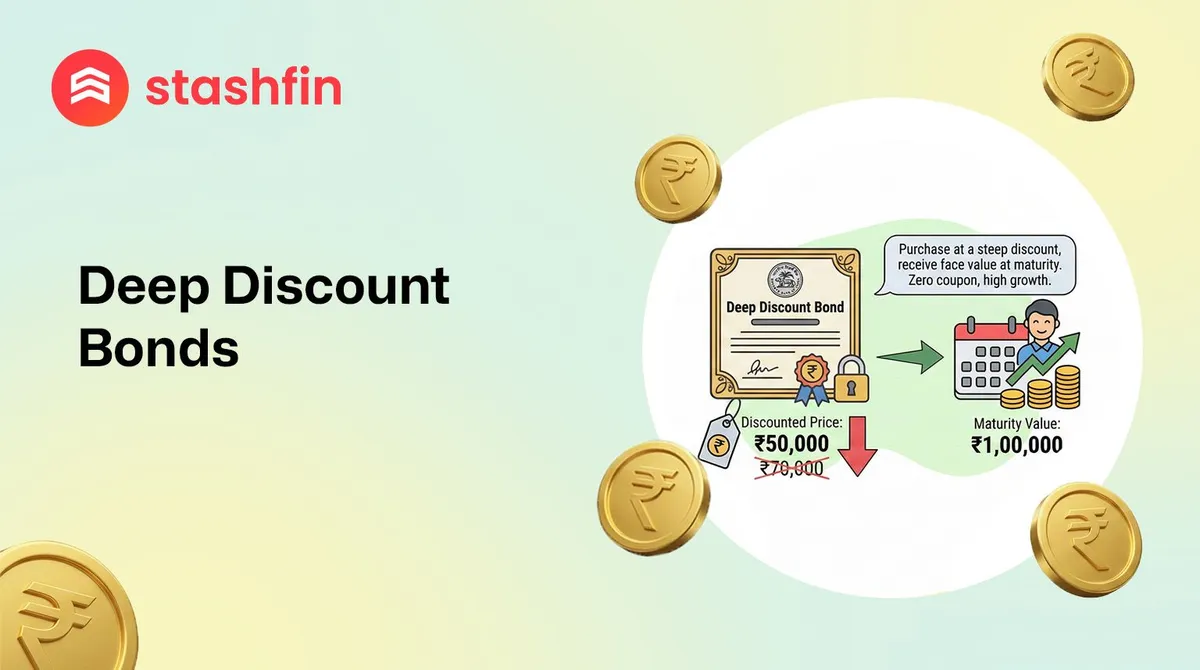
Deep Discount Bonds: Building Wealth Through Capital Appreciation
Master the unique strategy of investing at a fraction of the face value.

- High Capital Gains: Purchase bonds at a 20%+ discount and redeem at full par value.
- No Reinvestment Risk: Avoid the hassle of reinvesting small periodic interest payments.
- Long-Term Planning: Ideal for future milestones like retirement or a child's education.
What is a Deep Discount Bond?
A deep discount bond (DDB) is a type of debt instrument that is issued at a price significantly lower than its face value (par value). Unlike traditional bonds, it typically offers no periodic interest (coupon) payments. Instead, the investor’s return is the difference between the discounted purchase price and the full face value received at maturity.
In technical terms, a bond is considered "deeply discounted" if it is sold at a rebate of 20% or more to its par value. For example, a bond with a face value of ₹10,000 might be issued for ₹4,000. The ₹6,000 difference is your "interest," earned over the life of the bond.
Deep Discount Bonds in India: A Historical Perspective
India has a storied history with DDBs, primarily as a tool for Development Finance Institutions (DFIs) to raise long-term capital.
- IDBI Deep Discount Bonds (1992): One of the first major issues in India. These were issued at ₹2,700 with a face value of ₹1,00,000 and a 25-year tenure.
- NABARD Bhavishya Nirman Bonds: Highly popular among retail investors, these were issued at a discount (e.g., ₹9,250) to be redeemed at ₹20,000 after 10 years.
- 2026 Status: As of January 2026, many legacy issues from the early 2000s are reaching maturity. For instance, the IDFC First Bank Deep Discount series matured on January 16, 2026, providing a bullet redemption to long-term holders.
Deep Discount Bonds vs. Zero-Coupon Bonds
While the terms are often used interchangeably, there are subtle differences in the Indian market:
| Feature | Deep Discount Bond | Standard Zero-Coupon Bond |
|---|---|---|
| Discount Level | Significant (20% or more) | Can be small or large |
| Tenure | Usually Long-Term (5–25 years) | Can be Short-Term (T-Bills) |
| Tax Treatment | Annual Mark-to-Market | Often taxed at maturity/transfer |
| Issuer Type | Mostly Infrastructure/DFIs | Corporates and Governments |
Taxation of Deep Discount Bonds in India
In India, the taxation of DDBs is unique due to CBDT Circular No. 2/2002. To prevent tax deferral, the government requires investors to pay tax annually on an accrual basis.
- Annual Accrual: Every year, you must value the bond as of March 31st. The increase in value from the previous year is taxed as Interest Income (Income from Other Sources) at your applicable slab rate.
- Transfer/Sale: If you sell the bond in the secondary market before maturity, the difference between the sale price and your "cost", which includes previously taxed annual accretions, is treated as Capital Gains.
- Final Redemption: At maturity, the difference between the redemption value and the last recorded valuation is taxed as interest income.
Why this matters: Unlike the Akara Capital Bonds (14.5% p.a.) which pay you monthly cash to cover tax liabilities, DDBs require you to pay tax on "phantom income" (money you haven't received yet).
Pros and Cons of Deep Discount Bonds
Advantages
- No Reinvestment Risk: In a 5.25% Repo Rate environment where rates may fall further, DDBs "lock in" your yield for the entire tenure. You don't have to worry about where to invest small monthly coupons.
- Enforced Savings: The lump-sum payout at the end acts as a disciplined savings pot.
- Higher Potential Yields: Because they are often issued by entities needing long-term funding, the YTM is frequently higher than standard FDs.
Risks
- Liquidity Risk: These bonds often have low trading volumes in the secondary market. If you need money before maturity, you may have to sell at a steep discount.
- Tax Cash Outflow: You must have the cash ready to pay annual taxes on the bond's appreciation, even though you haven't received a payout.
- Credit Risk: Since these are long-term, you are betting on the issuer's health for 10–20 years.


