





















 Back
Back
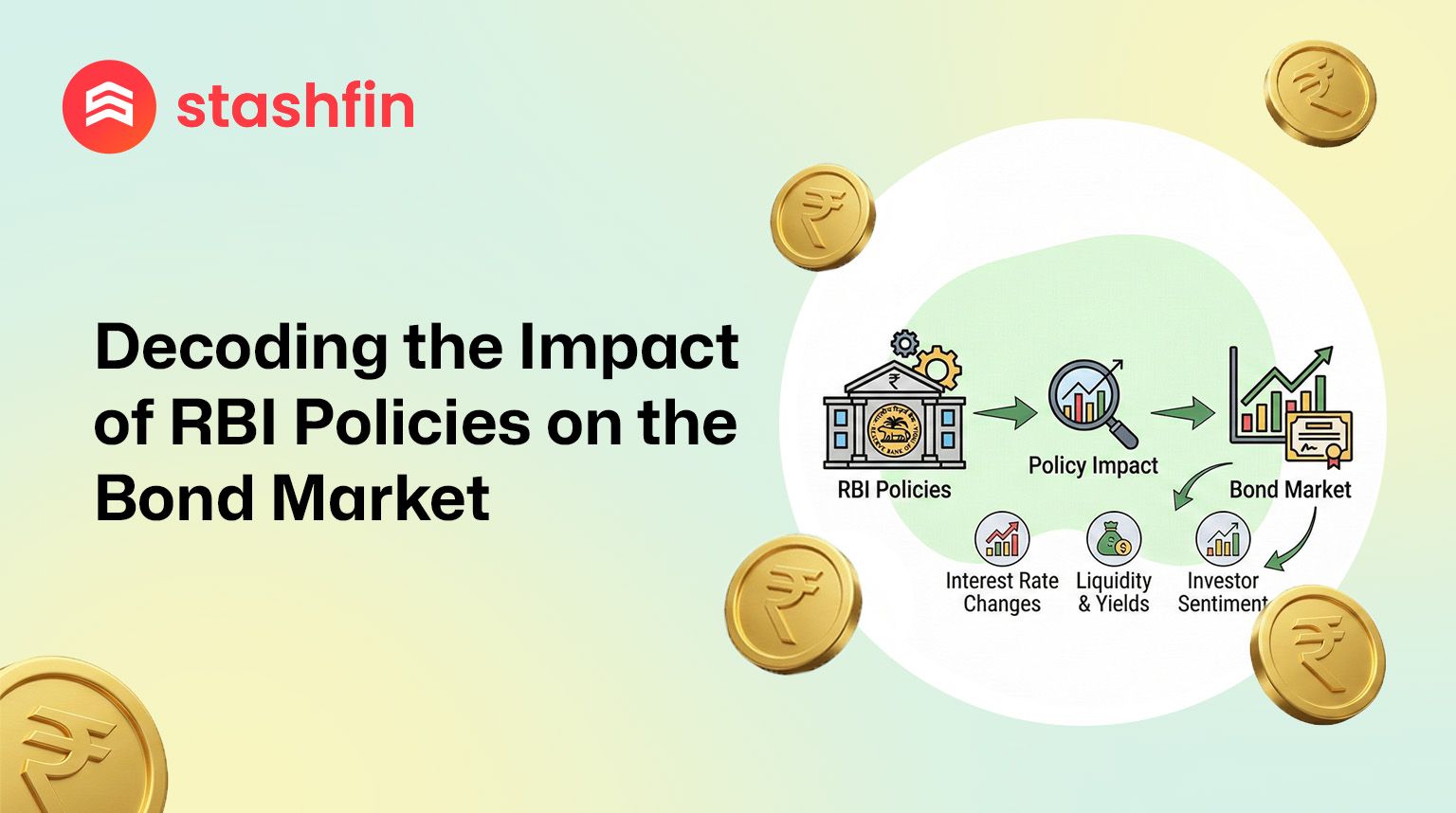

Decoding RBI Policies: The Pulse of the Indian Bond Market
Master the relationship between central bank mandates and your fixed-income portfolio.


- Rate Cycle Strategy: Learn how the 5.25% Repo Rate (as of February 2026) dictates bond pricing.
- Liquidity Management: Understand how CRR (3.0%) and SLR (18.0%) adjustments affect market yields.
- Policy Transmission: See how RBI mandates directly influence high-yield opportunities like Akara Capital's 14.5% p.a. yields.
- Regulatory Shield: Navigate bond market RBI regulations designed to protect retail investors.
The "Inverse Relationship" Law
The most direct impact of RBI policy on bond market performance is the inverse relationship between interest rates and bond prices.
- When RBI Cuts Rates (Dovish): New bonds are issued with lower interest rates. Consequently, existing bonds with higher coupons become "hot property." Their market price rises, allowing you to sell at a premium.
- When RBI Raises Rates (Hawkish): New bonds offer better returns, making older, lower-coupon bonds less attractive. Their market price falls.
In early 2026, with the Repo Rate stabilized at 5.25% following a series of cumulative cuts (125 bps since 2025), the market is in a "neutral-to-pause" phase. This is an ideal window to lock in high-coupon corporate bonds before any potential further rate compression.
Key RBI Policy Tools and Their Impact
The RBI uses several levers beyond the Repo Rate to manage the bond market environment:
1. Open Market Operations (OMO)
The RBI buys or sells government securities (G-Secs) to inject or absorb liquidity.
- Buying G-Secs: Increases cash in the system, leading to lower yields and higher bond prices.
- Selling G-Secs: Mops up excess cash, pushing yields higher.
2. Cash Reserve Ratio (CRR) and Statutory Liquidity Ratio (SLR)
These regulations dictate the minimum liquidity banks must maintain.
- Current Status (Feb 2026): CRR stands at 3.0% and SLR at 18.0%.
- Impact: A hike in these ratios reduces the "lendable" money with banks, often causing corporate debt interest rates to rise as companies compete for a smaller pool of capital.
3. "Operation Twist"
A maneuver where the RBI simultaneously buys long-term bonds and sells short-term bonds.
- The Goal: To flatten the yield curve, making long-term borrowing cheaper for corporations and the government without changing the headline Repo Rate.
Bond Market RBI Regulations for Retail Investors
In 2026, the RBI has intensified its focus on "Retail Direct" and secondary market transparency. Key regulations include:
- RBI Retail Direct Portal: Enables retail investors to buy G-Secs, T-Bills, and Sovereign Gold Bonds directly with zero account opening or maintenance fees.
- Credit Enhancement: Regulations that encourage companies to provide "guarantees" for their bonds, improving their credit ratings and safety for individual buyers.
- Fair Pricing Mandates: Ensuring that digital platforms provide transparent, real-time pricing for secondary market trades to prevent retail exploitation.
Why Akara Capital Bonds Thrive Under RBI Policy
While the RBI focuses on benchmark G-Sec rates, corporate bonds like those from Akara Capital provide the "Spread" or extra return.
| Feature | Impact of 5.25% Repo Rate Environment |
|---|---|
| High Spread | With the Repo at 5.25%, a 14.5% bond offers a massive 9.25% premium over the benchmark. |
| Fixed Coupon Certainty | Unlike floating-rate bonds, Akara’s fixed 12-month tenure protects you from potential rate volatility. |
| Short Duration Advantage | Short-term bonds (under 1 year) are less sensitive to RBI rate hikes than 10-year bonds, offering a "safer" bet in 2026. |

