


 Back
Back
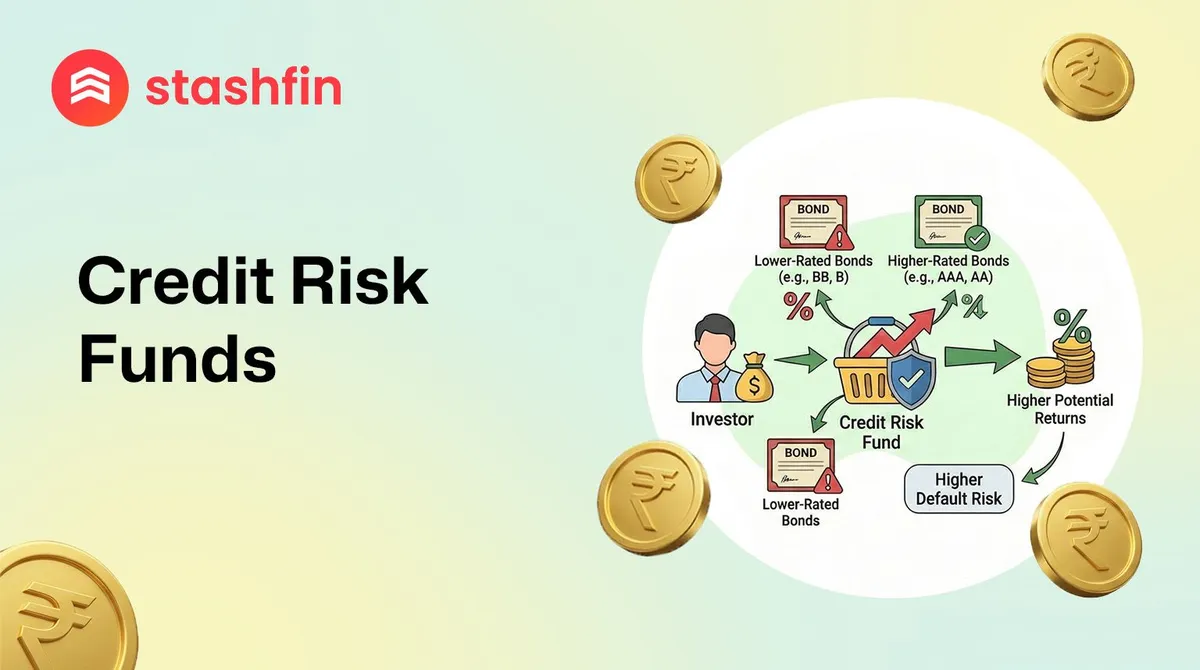

Credit Risk Funds: Capturing the Yield Premium
Turn credit opportunities into consistent wealth through strategic debt investing.


- Higher Yield Potential: Target 8–12% returns by investing in lower-rated corporate debt.
- Credit Opportunity: Benefit from "rating upgrades" that provide sharp capital gains.
- Professional Selection: Fund managers perform deep-dive research into company balance sheets.
Credit Risk Fund Meaning & SEBI Rules
A credit risk fund is a category of debt mutual fund that must invest at least 65% of its assets in corporate bonds rated AA or below (excluding AA+).
Unlike Corporate Bond Funds that stick to high-safety AAA paper, credit risk funds intentionally lend to companies with "moderate" ratings. Because these companies carry a higher risk of default, they pay a higher interest rate (coupon), which the fund passes on to you.
How "Credit Opportunity Funds" Work
Historically known as credit opportunity funds, these schemes don't just sit on interest. They play for two types of gains:
- Accrual Income: Earning the high interest paid by the borrower.
- Capital Gains (Rating Play): If a company rated "BBB" improves its financials and gets upgraded to "A," the price of its bond jumps significantly, giving the mutual fund an extra profit.
Comparison: Credit Risk Funds vs. High-Yield Direct Bonds
In the 2026 landscape, investors are choosing between the diversification of a fund and the concentrated high returns of direct bonds.
| Feature | Credit Risk Mutual Funds | Akara Capital Bonds (Direct) |
|---|---|---|
| Target Return | ~8.5% - 11% p.a. | 14.5% p.a. |
| Minimum Investment | Often ₹500 (SIP) | ₹10,000 |
| Management Cost | 0.7% - 1.2% (Expense Ratio) | NIL |
| Diversification | High (20-40 Issuers) | Low (Single Issuer) |
| Payouts | Market-linked (NAV) | Fixed Monthly Returns |
| Tenure | Best for 3–5 Years | 12 Months |
Understanding Credit Risk in Mutual Funds
While the returns are attractive, credit risk in mutual funds involves specific "downside" factors:
- Default Risk: If one of the companies in the fund's portfolio fails to pay, the NAV can drop sharply (e.g., a "side-pocketing" event).
- Liquidity Risk: Lower-rated bonds (AA or BBB) are harder to sell quickly. In a market panic, the fund might struggle to meet redemption requests.
- Interest Rate Risk: Since these are medium-term funds, their value can fluctuate when the RBI changes the 5.25% Repo Rate.


