


Introduction
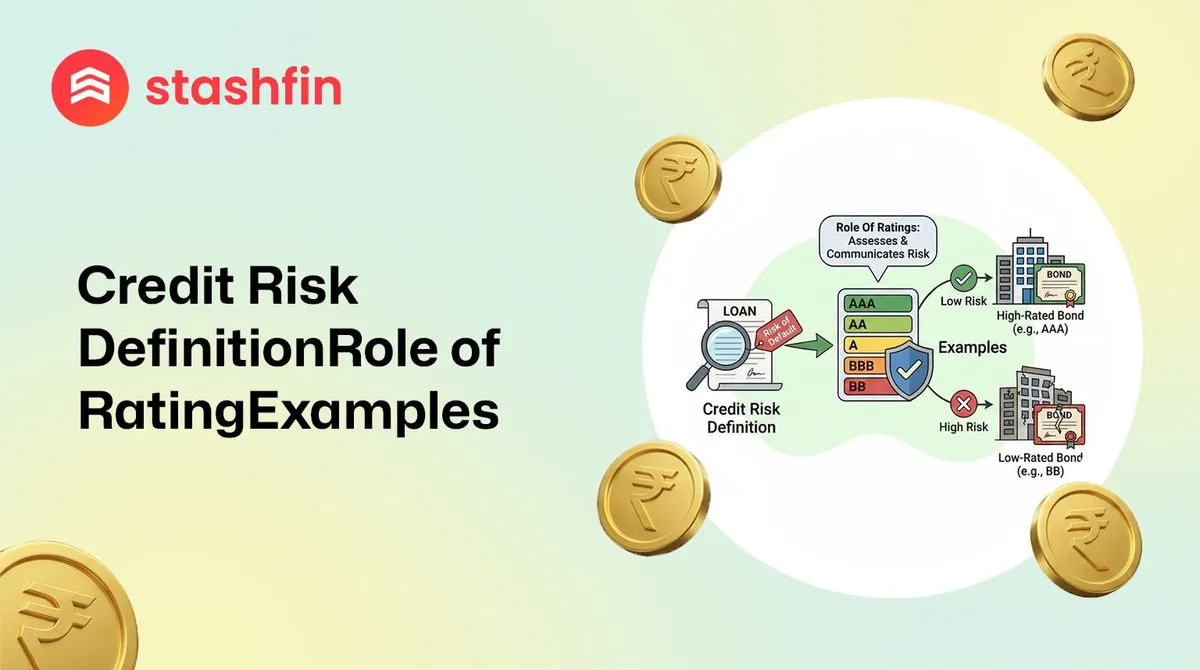
Credit risk in the simplest terms is the danger that the issuer of a bond will "default"—meaning they won't pay you the interest or principal they promised.

When you invest in a bond, you are a creditor. If the company’s business suffers due to a recession, poor management, or industry disruption, they might run out of cash. This risk manifests in three specific ways:
- Default Risk: The most severe form, where the company stops making payments entirely.
- Downgrade Risk: A rating agency lowers the company’s grade (e.g., from A to BBB). This often causes the bond's market price to drop immediately, even if the company is still paying interest.
- Spread Risk: The market becomes "scared" and demands a much higher premium for that company’s debt compared to safe government bonds, leading to price volatility.
The Crucial Role of Credit Ratings
Credit ratings act as a "financial health certificate" for companies. In India, SEBI-regulated agencies like CRISIL, ICRA, and CARE (CareEdge) analyze a company’s balance sheet, cash flows, and management quality to assign a standardized grade.
The Rating Scale and Its Implications (2026)
| Rating Category | Meaning | Risk Level | 2026 Market Context |
|---|---|---|---|
| AAA | Highest Safety | Minimal | Lowest yields (~7.5%); often PSUs or Blue-chips. |
| AA | High Safety | Low | "Goldilocks" zone for many conservative HNIs. |
| A | Adequate Safety | Low-Moderate | Sensitive to economic cycles but generally stable. |
| BBB | Moderate Safety | Moderate | Investment Grade. Offers highest yields (~14.5%). |
| BB and Below | Speculative/Junk | High | Often called "High Yield" or "Junk" bonds. |
Investor Insight: A BBB rating (like Akara Capital) is the threshold for "Investment Grade." It is designed to offer the highest possible yield while remaining within the safety net of institutional oversight and mandatory regulatory monitoring.
Real-World Credit Risk Example
To understand how credit risk works in practice, let’s compare two 2026 investment scenarios based on the current 6.70% G-Sec benchmark.
- Example A (Low Credit Risk): You invest in a AAA-rated PSU bond. Because the risk of it failing is nearly zero, they only offer you a 7.5% p.a. return. You are paying for safety by accepting a lower yield.
- Example B (Measured Credit Risk): You invest in Akara Capital Bonds (BBB-rated). As a high-growth NBFC, there is a "moderate" risk compared to a massive state-owned bank. To compensate you for this, they offer a 14.5% p.a. return.
The Result: For the additional credit risk you assume in Example B, you earn an extra 7.0% in annual interest. This is known as the Credit Spread.
Managing Credit Risk in Your Portfolio
In the 2026 economic environment, with the RBI Repo Rate at 5.25%, managing risk is about smart allocation, not total avoidance:
- Don't Put All Eggs in One Basket: Avoid Concentration Risk by limiting your exposure to a single issuer to 10-15% of your total debt portfolio.
- Focus on Tenure: Shorter tenures (like the 12-month cycle at Stashfin) naturally reduce credit risk because there is less time for a company’s financial situation to deteriorate.
- Check the "Moat": Invest in sectors that are essential to the economy—like Financial Services or Infrastructure—which are often more resilient than speculative tech or retail industries.
- Monitor Ratings Regularly: Ratings are not static. In 2026, agencies are increasingly using AI-driven real-time monitoring to update outlooks, so keep an eye on your bond's rating status through your investment dashboard.


