


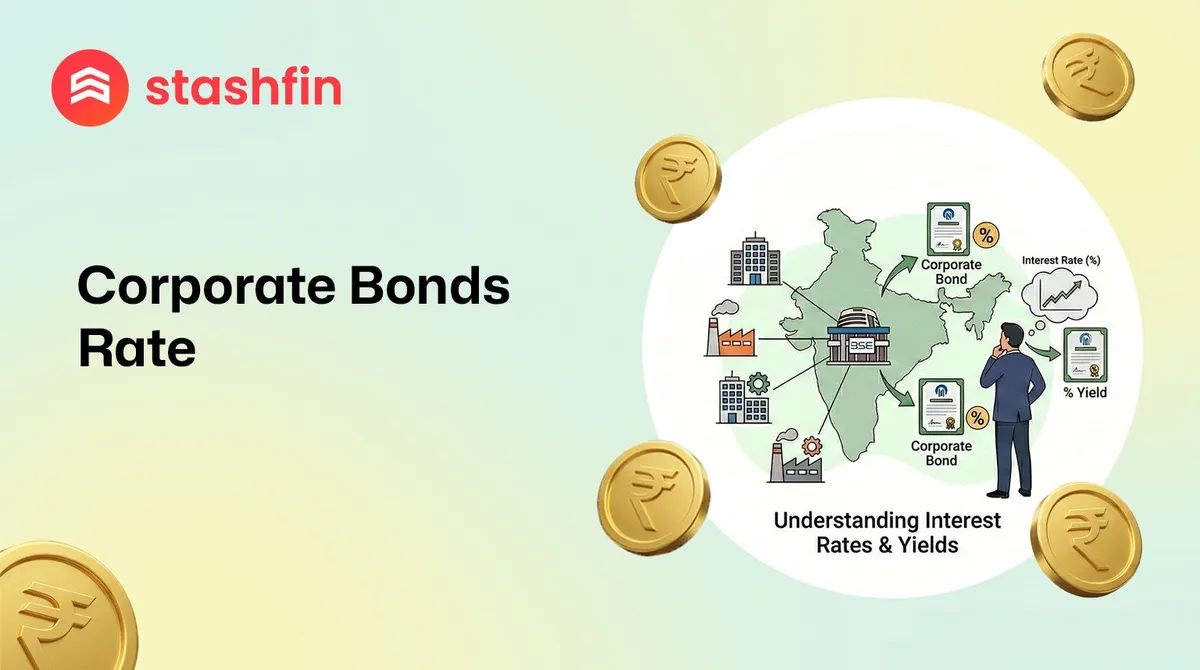
Corporate Bond Rates in India: 2026 Yield Analysis
Understanding Corporate Bond Interest Rates
The corporate bond rate of interest is not a single number; it is a "risk-adjusted" return. Unlike a bank FD which is largely uniform, corporate debt rates are determined by a simple formula:

$$Corporate\ Bond\ Yield = Risk\text{-}Free\ Rate\ (G\text{-}Sec) + Credit\ Spread$$
As of February 4, 2026, the 10-year Government Security (G-Sec) yield is approximately 6.70%. Any yield above this is the "Credit Spread" you earn for lending to a private company rather than the sovereign.
Current Corporate Bond Rates in India (2026)
In the current market, corporate debt interest rates vary significantly based on the credit rating assigned by agencies like CRISIL, ICRA, or CARE. Following the Union Budget 2026, yields have hardened due to record government borrowing plans.
| Credit Rating | Typical Yield Range (p.a.) | Security Level |
|---|---|---|
| AAA (Highest Safety) | 7.5% – 8.5% | Very High |
| AA (High Safety) | 8.5% – 10.5% | High |
| A (Adequate Safety) | 10.5% – 12.5% | Moderate |
| BBB (Moderate Safety) | 12.5% – 15.0% | Average |
Factors Influencing Corporate Bond Yield Rates
Why do corporate bond yield rates fluctuate? For a 2026 investor, three factors are paramount:
- Monetary Policy: Since the RBI Repo Rate stands at 5.25% (following cumulative easing of 125 bps in 2025), bond yields have moderated compared to previous years. When the RBI pauses or cuts rates, existing high-yield bonds (like your 14.5% units) become more valuable in the secondary market.
- Inflation Expectations: With the new CPI series released in 2026, inflation readings are closely monitored. If inflation rises, investors demand higher bond interest rates to maintain real purchasing power.
- Liquidity in the System: The RBI is currently using Open Market Operations (OMOs) and bond purchases to manage liquidity. Tight liquidity pushes corporate bond rates higher as companies compete for a smaller pool of funds.
Why the Akara Capital 14.5% Rate is a Winner
Stashfin provides access to bonds that offer a significant "Alpha" over standard market rates. The Akara Capital Bonds (14.5% p.a.) stand out because:
- Massive Spread: They offer a 925 bps (9.25%) spread over the current RBI Repo Rate.
- Short Duration: While most high-yield bonds require a 3–5 year lock-in, Akara offers this competitive rate for a 12-month tenure.
- Fixed Monthly Credits: Unlike the annual or semi-annual payouts typical of institutional bonds, Akara provides monthly interest, providing immediate liquidity and improving your effective XIRR.
Note: Corporate bond yields move inversely to prices; as market yields rise due to government borrowing pressure, locking in fixed high-coupon rates provides a critical hedge for your portfolio.


