





















 Back
Back
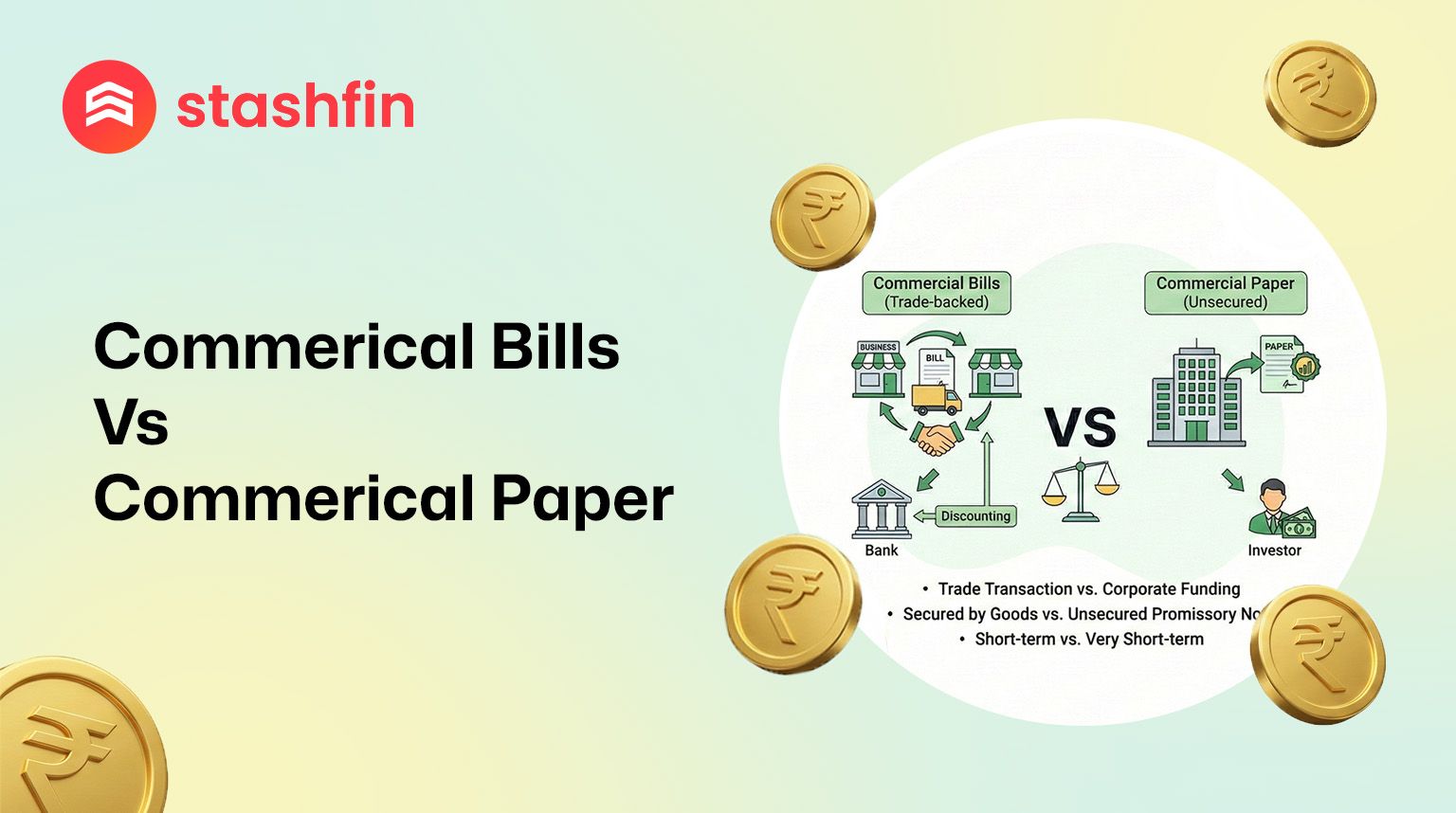

Commercial Bill vs. Commercial Paper: Introduction
What is Commercial Paper and Commercial Bill?
To grasp the difference between commercial paper and commercial bill, you must first understand their distinct roles in the financial ecosystem.
Download Stashfin App


- What is Commercial Paper (CP)?
Commercial Paper is an unsecured money market instrument issued in the form of a promissory note. It was introduced in India to enable highly rated corporate borrowers to diversify their sources of short-term borrowings. Since it is unsecured, only companies with high credit ratings (typically A3 or above) can issue CPs. - What is a Commercial Bill (CB)?
A Commercial Bill, often referred to as a Bill of Exchange, is a trade-related instrument. It arises from a genuine credit sale of goods or services. When a seller (drawer) provides goods to a buyer (drawee) on credit, they draw a bill that the buyer "accepts," promising to pay at a future date.
Key Differences: Commercial Bill vs. Commercial Paper
In the 2026 landscape, where the RBI Repo Rate is 5.25%, the choice between these two instruments for institutions depends on the underlying need: funding or trade.
| Feature | Commercial Paper (CP) | Commercial Bill (CB) |
|---|---|---|
| Nature | Unsecured Promissory Note | Trade-linked Bill of Exchange |
| Issuer | Highly rated Corporates/PDs | Buyers & Sellers in a trade |
| Tenure | 7 Days to 1 Year | 30 to 180 Days (Typical) |
| Purpose | Seasonal/Working Capital needs | Financing credit sales (Trade) |
| Security | Unsecured (Issuer's Credit) | Secured (Underlying Goods) |
| Minimum Ticket | ₹5 Lakh (Multiples thereof) | Varies by invoice value |
| Regulation | Regulated by RBI | Negotiable Instruments Act |
Features and Benefits of Commercial Paper
- Low Cost: Highly rated companies can raise funds at rates lower than bank loans.
- Digital Convenience: Issued exclusively in dematerialised (demat) form via NSDL/CDSL.
- Flexibility: Companies use CPs to meet payroll, inventory, and short-term liabilities without pledging assets.
- Secondary Market: CPs are highly liquid and tradable among institutional investors.
Features and Benefits of Commercial Bills
- Self-Liquidating: The bill is automatically "cleared" when the buyer pays for the goods at the end of the term.
- Bank Discounting: A seller doesn't have to wait for the maturity date; they can take the bill to a bank and get it discounted for immediate cash.
- Safety: Because they are backed by physical trade, they are considered lower risk than unsecured paper.
- Money Market Liquidity: Banks can "rediscount" these bills with the RBI to manage their own liquidity.
The Retail Investor's Perspective: Why 14.5% Bonds Win
While CPs and CBs are vital for the economy, they are primarily institutional tools with high entry barriers (₹5 Lakh+). For retail investors seeking similar fixed-income stability with much higher yields, Akara Capital Bonds provide the perfect alternative.
| Feature | Institutional CPs/CBs | Akara Capital Bonds |
|---|---|---|
| Annual Yield | ~7.5% - 8.5% p.a. | 14.5% p.a. |
| Standard Tenure | 7 Days to 1 Year | 1 Year |
| Entry Point | ₹5,00,000 | ₹10,000 |
| Payout | Mostly at Maturity | Fixed Monthly Returns |

