


 Back
Back
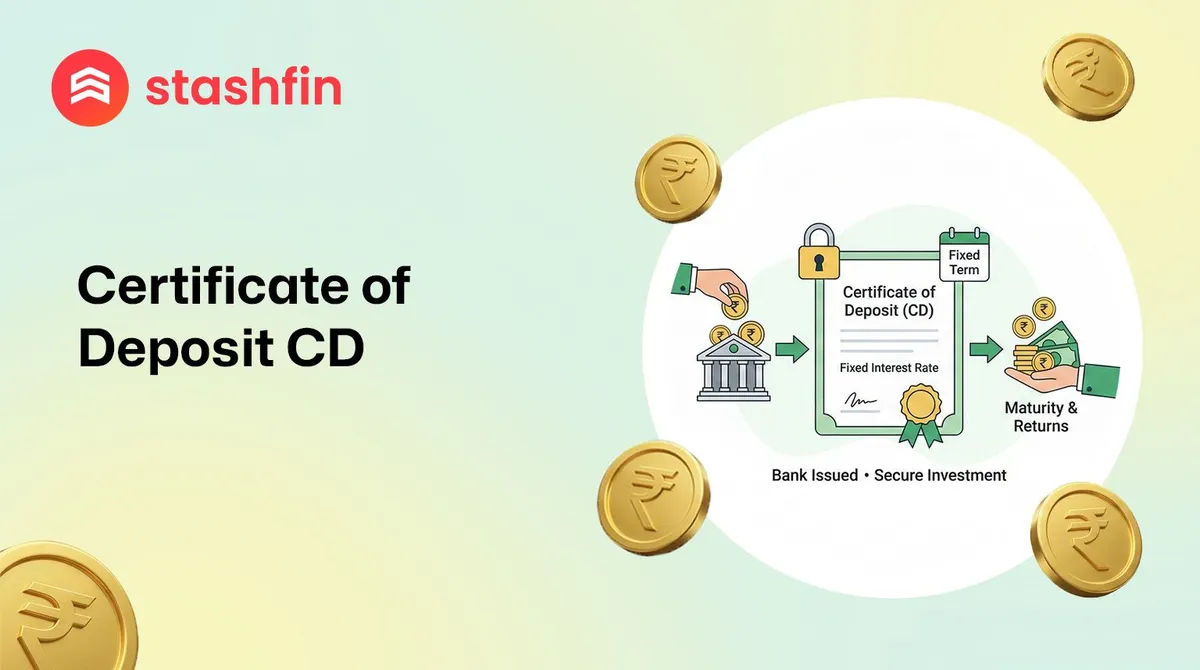

Certificate of Deposit (CD): Secure Your Surplus with Bank-Backed Yields
What is a Certificate of Deposit (CD)?
A Certificate of Deposit (CD) is a negotiable money market instrument issued in dematerialised form against funds deposited at a bank or an eligible financial institution for a specified time period.


Introduced in India in 1989, CDs serve as a bridge for banks to raise short-term resources. Unlike regular savings, a CD is a "Time Deposit" where the interest rate is pre-determined and the capital is locked until maturity, offering higher yields than standard savings accounts.
Key Features of a Certificate of Deposit in India
As of 2026, the RBI-governed guidelines for CDs provide a structured framework for investors:
- Minimum Investment: The minimum amount for a CD is ₹1 Lakh, and in multiples of ₹1 Lakh thereafter.
- Issuing Entities: Only Scheduled Commercial Banks (SCBs) and select All-India Financial Institutions (AIFIs) can issue CDs.
- Flexible Tenure: * Banks: 7 days to 1 year.
- Financial Institutions: 1 year to 3 years.
- Demat Form: Most CDs are now issued electronically, ensuring security and ease of tracking.
- Transferability: Being negotiable instruments, they can be traded in the secondary market after a specified period.
- No Loan Facility: Banks are strictly prohibited from granting loans against Certificates of Deposit.
Features and Benefits: CD vs. Fixed Deposit (FD)
While they may seem similar, the difference between CD and FD is significant for a high-net-worth investor.
| Feature | Certificate of Deposit (CD) | Standard Fixed Deposit (FD) |
|---|---|---|
| Minimum Amount | ₹1,00,000 | Generally ₹1,000 |
| Issuer | Select Banks & FIs | Almost all Banks & NBFCs |
| Transferability | Freely Transferable (Negotiable) | Non-Transferable |
| Loan Against TD | Not Allowed | Allowed (up to 90%) |
| Target Audience | Institutions & HNI Investors | Retail Individuals |
| Liquidity | High (Secondary Market) | Moderate (Premature Withdrawal) |
The Yield Benchmark: CDs vs. Akara Capital Bonds (14.5%)
In the 2026 landscape, CDs offer safety, but for those seeking to maximize their wealth, corporate bonds provide the necessary "Alpha."
| Feature | Bank Certificate of Deposit | Akara Capital Bonds |
|---|---|---|
| Annual Yield | ~7.0% - 8.0% p.a. | 14.5% p.a. |
| Standard Tenure | 3 Months - 1 Year | 1 Year |
| Payout Frequency | At Maturity | Fixed Monthly Returns |
| Interest Type | Fixed or Floating | Fixed |
| Market Access | Institutional Platforms | 100% Digital (Stashfin App) |
Investor Strategy: Use CDs for ultra-safe parking of large corporate surpluses (₹50L+), and utilise Akara Capital Bonds (14.5%) for personal wealth growth and regular monthly cash flow.
Eligibility: Who Can Invest in CDs?
The Reserve Bank of India permits a wide range of entities to subscribe to CDs:
- Individuals: Resident Indians looking for stable bank yields.
- Corporations: Companies with short-term idle cash.
- Trusts & Funds: Mutual funds and provident funds seeking low-risk debt.
- Non-Resident Indians (NRIs): Eligible to invest on a non-repatriable basis only.
How to Invest in a Certificate of Deposit
- Check Availability: Look for active CD issuances from major banks.
- KYC Compliance: Ensure your PAN and Aadhaar are linked to your Demat account.
- Application: Apply through your bank's net banking portal or a dedicated wealth management platform.
- Allotment: Units will be credited to your Demat account in electronic form.


