


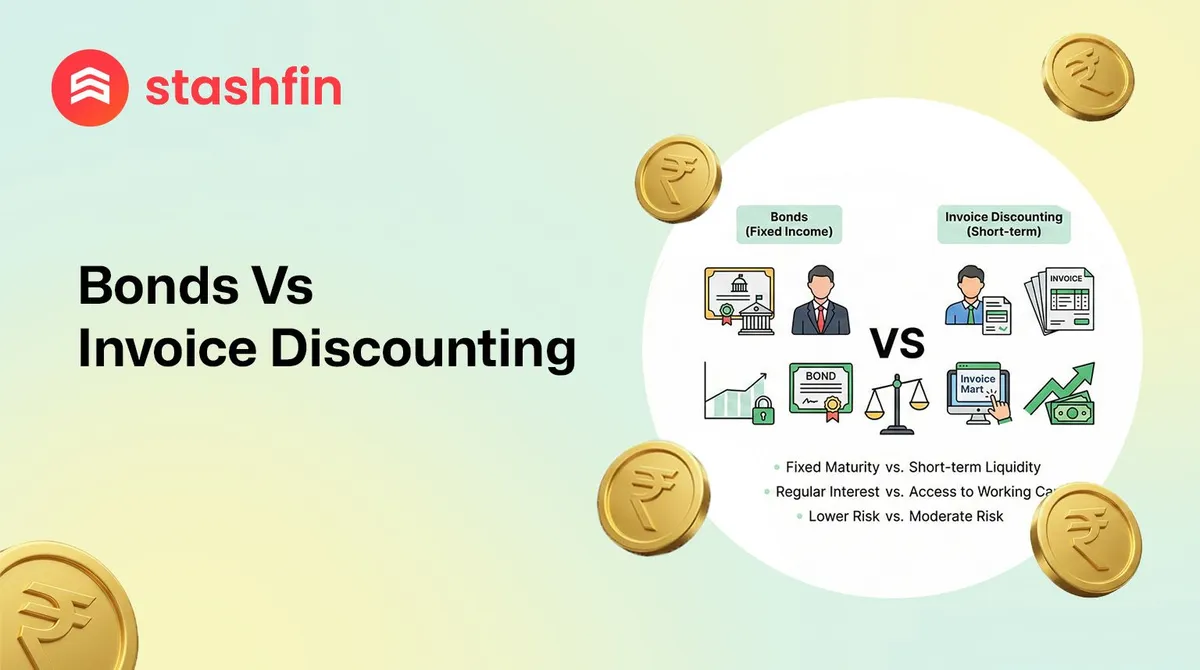
Bonds vs. Invoice Discounting: Navigating Private Debt in 2026
What is an Invoice Discounting Investment?
Invoice discounting is a form of short-term financing where businesses sell their unpaid global or domestic invoices to investors at a discount. In return, investors receive the full value of the invoice when the end-customer (the debtor) pays.

While it offers quick turnarounds of usually 30 to 90 days, it is categorised as operational debt. In the event of a company’s insolvency, financial creditors (bondholders) generally have higher repayment priority than operational creditors (invoice investors).
Bonds vs. Invoice Discounting: A Comparative Analysis
In the 2026 financial landscape, with the RBI Repo Rate at 5.25%, both assets serve as high-yield alternatives to FDs, but their structures differ significantly.
| Feature | Corporate Bonds (Akara Capital) | Invoice Discounting |
|---|---|---|
| Annual Yield | 14.5% p.a. (Fixed) | ~10% - 14% (Variable) |
| Tenure | 1 Year | 30 - 90 Days |
| Regulation | SEBI Regulated | Platform-led (Unregulated) |
| Credit Rating | BBB (Stable) | Usually Unrated |
| Debt Type | Financial Debt (Senior) | Operational Debt |
| Payout | Monthly Interest | Lump Sum at Maturity |
The Risk Factor: Why Regulation Matters
When comparing bonds vs. invoice discounting, the level of oversight is a primary concern for retail investors.
- Bonds: Corporate bonds are regulated by SEBI. They undergo rigorous credit rating assessments by independent agencies (like CRISIL or ICRA).
- Invoice Discounting: This is an alternative investment often hosted on fintech platforms. While lucrative, these investments are typically unrated and unsecured. If the end-customer defaults on the invoice, the investor may face long recovery periods without the protection of a regulated trustee.
Repayment Seniority (IBC 2016)
Under India's Insolvency and Bankruptcy Code (IBC), the hierarchy of claims is strict. If an issuer faces financial distress, secured financial creditors (bondholders) are paid well before operational creditors.
Why Choose Akara Capital Bonds Over Invoice Discounting?
While invoice discounting offers very short bursts of liquidity, the Akara Capital bond provides a superior balance of "Yield-to-Safety."
- Higher Certainty: Lock in 14.5% for nearly a year, whereas invoice yields fluctuate with every new deal.
- Regulated Structure: Your investment is held in a Demat Account, providing digital security and proof of ownership.
- Monthly Income: Invoice discounting only pays you when the invoice clears. Akara Capital pays you monthly interest, allowing for immediate reinvestment or expense management.
- Low Entry Barrier: Start building your bond portfolio with just ₹10,000.
How to Invest via Stashfin
Stashfin simplifies the complex world of fixed income into 4 paperless steps:
- Verify: Add your demat account & complete instant KYC with PAN and Aadhaar.
- Transfer: Invest via UPI or Net Banking.
- Track: Monitor your monthly payouts and 12-month maturity directly in the app.


